

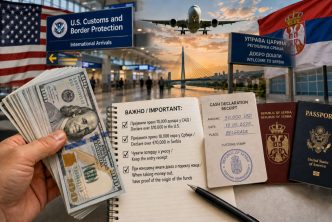
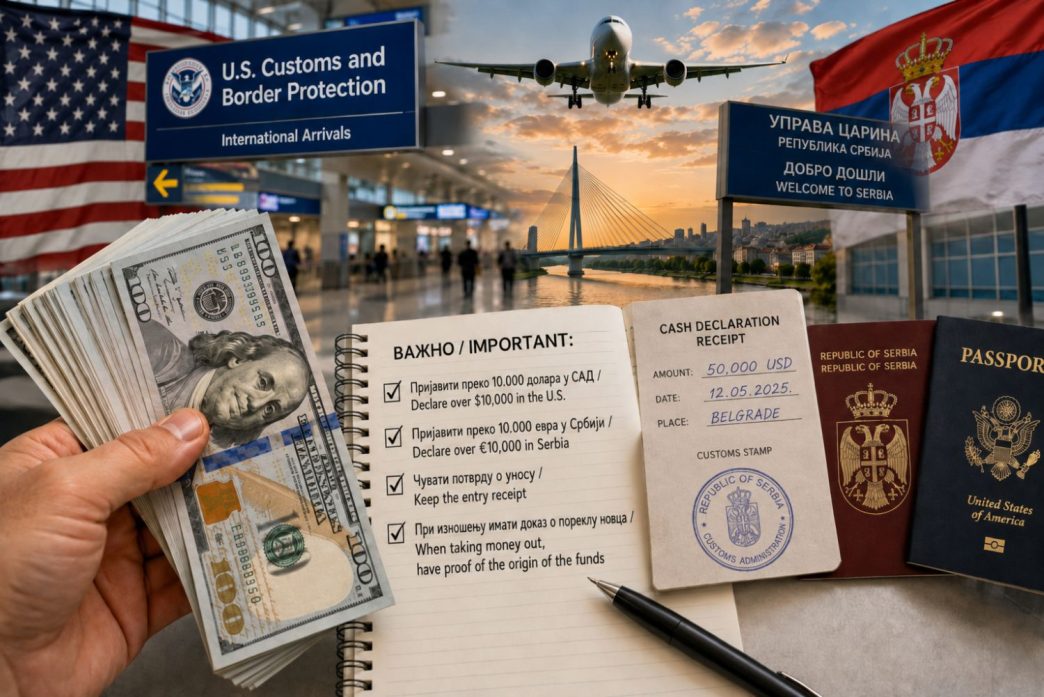
Can you leave the United States carrying $20,000 or $50,000 in cash? What happens if you arrive at Belgrade Airport with a large amount of money, and do you have to pay tax on cash you declare? The well-known “$10,000 rule” is often misunderstood as a limit on how much cash you are legally allowed to carry. In reality, both the United States and Serbia allow travelers to cross the border with larger amounts of cash, but both countries have rules governing when that money must be declared.
The rules, however, are not exactly the same. The U.S. threshold is denominated in dollars, while Serbia’s is denominated in euros. There are also additional restrictions to consider if you want to take a large amount of cash out of Serbia.
You Can Leave the United States With $50,000 — but You Have to Declare It
U.S. law does not prohibit you from leaving the country with more than $10,000 in cash. You can travel with $20,000, $50,000, or even more, provided that you comply with the reporting requirements.
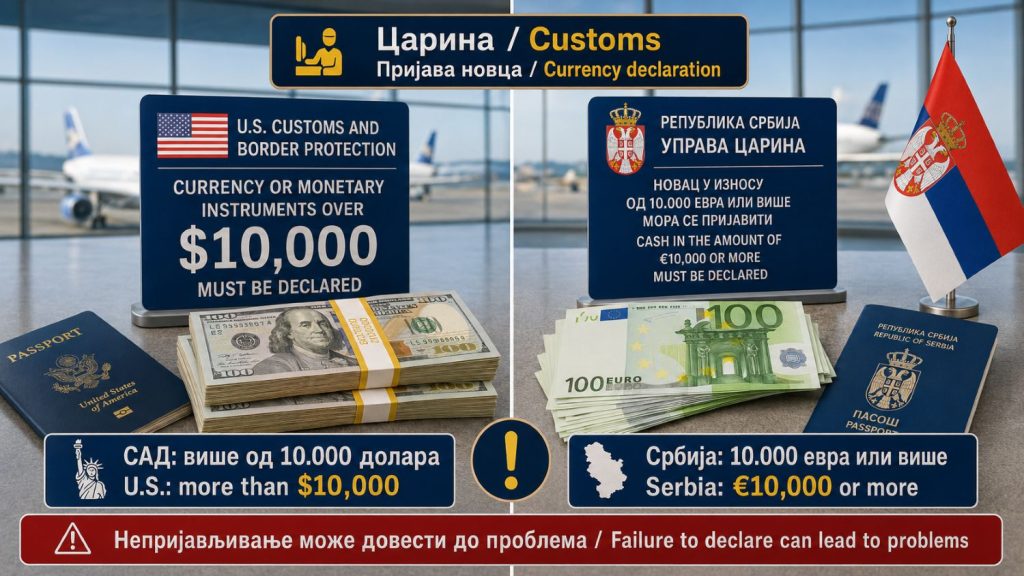
U.S. Customs and Border Protection (CBP) states that there is no limit on the amount of money that may be brought into or taken out of the United States. However, if a person is carrying more than $10,000, the money must be declared.
This is done using FinCEN Form 105 – Report of International Transportation of Currency or Monetary Instruments. The form can be filed electronically, and CBP also provides procedures for reporting the money when entering or leaving the country.
In other words, $10,000 is not the maximum amount of cash you are legally allowed to carry. It is the threshold above which the reporting requirement applies.
Splitting the Money Among Family Members Is Not a Way Around the Rule
Families traveling together need to be particularly careful. CBP states that when a family files a joint customs declaration, the total amount of money carried by all family members is taken into account.
In other words, having one spouse carry $9,000 and the other carry another $9,000 does not necessarily allow a family to avoid the reporting requirement simply because neither individual is carrying more than $10,000.
U.S. rules are specifically designed to prevent travelers from intentionally dividing larger amounts of money in an attempt to avoid reporting requirements.
What Happens When You Arrive in Serbia With the Cash?
Declaring the money when leaving the United States does not mean that you have completed all the required formalities. Once you enter Serbia, Serbian rules apply.
There is no maximum amount of foreign currency that you may bring into Serbia. However, Serbia’s Customs Administration states that €10,000 or more, whether in dinars or foreign currency, must be declared to Customs upon entry.
For example, if you travel from the United States with $15,000, you would need to declare the money when leaving the U.S. and again when entering Serbia, because its value exceeds Serbia’s €10,000 threshold. If you are carrying a smaller amount — for example, $10,000 — you would not need to declare it in Serbia as long as its value remains below €10,000.
Declaring Cash Does Not Mean You Have to Pay Tax on It
This is probably the most common misconception about carrying cash across international borders.
If you declare that you are bringing, for example, $30,000 into Serbia, you do not owe customs duty or tax simply because you declared the money. Serbia’s Customs Administration states that no fee is charged on the amount declared.
The purpose of the declaration is to create an official record of larger amounts of cash crossing the border. The source of the money and any potential tax obligations are separate issues.
So if someone legally earned and saved $30,000 in the United States, that person does not pay tax on the same $30,000 again simply because the money was physically brought into Serbia.
Keep the Declaration You Receive at the Serbian Border
When you declare a larger amount of cash upon entering Serbia, Customs provides you with documentation confirming the declaration. Do not throw it away once you leave the airport.
It serves as proof that you legally brought that amount of money into Serbia and can become very important if you later decide to take the money back out of the country.
This is particularly relevant for people who divide their time between Serbia and the United States and may not know in advance whether they will spend or invest all the money they bring into Serbia.
Taking Larger Amounts of Cash Out of Serbia Is More Complicated
The rules become stricter when traveling in the opposite direction.
Serbia’s Customs Administration states that residents and non-residents may take up to €10,000 in cash, or its equivalent in another foreign currency, out of Serbia.
Taking €10,000 or more out of the country is subject to additional requirements. A non-resident, for example, may take out a larger amount that was previously declared upon entering Serbia, provided that they have the appropriate Customs documentation. A bank certificate showing that the money was withdrawn from the person’s foreign-currency account in Serbia may also be relevant.
The rules are more restrictive for Serbian residents. According to the Customs Administration, a resident may take €10,000 or more out of the country when emigrating from Serbia, provided that they can produce evidence of emigration.
It therefore matters whether you are a Serbian resident, live in the United States and are only temporarily staying in Serbia, or are permanently moving out of Serbia.
What if You Brought $50,000 From the United States and Later Want to Take It Back?
Suppose you live in the United States and travel to Serbia carrying $50,000 of your own savings. You declared the money to U.S. authorities when leaving the country and then declared it to Serbian Customs when you arrived in Belgrade, receiving documentation confirming the declaration.
If you are a non-resident of Serbia and later want to take that money out of the country, the declaration showing that you previously brought the cash into Serbia can be used as evidence of where the larger amount of cash came from.
If you failed to declare the money when entering Serbia even though you were required to do so, you will not have that documentation later. Declaring the money is therefore not only a legal obligation; it can also protect you if you later want to take the funds back out of Serbia.
You Must Declare the Cash Again When Entering the United States
If you are traveling from Serbia to the United States with a large amount of cash, you need to comply with the rules of both countries.
Serbian rules governing the export of foreign currency apply first. Once you arrive in the United States, the U.S. threshold applies again: if you are bringing more than $10,000 into the country, you must declare it.
What Happens if You Fail to Declare the Money?
This is not a requirement worth trying to circumvent. CBP warns that failure to report money when required can result in seizure of the funds, as well as civil and criminal penalties.
Serbian law also provides penalties for travelers who fail to declare amounts that are subject to mandatory reporting. Attempting to avoid the requirement by splitting the money, concealing cash, or providing false information can therefore create a far more serious problem than simply declaring it.