



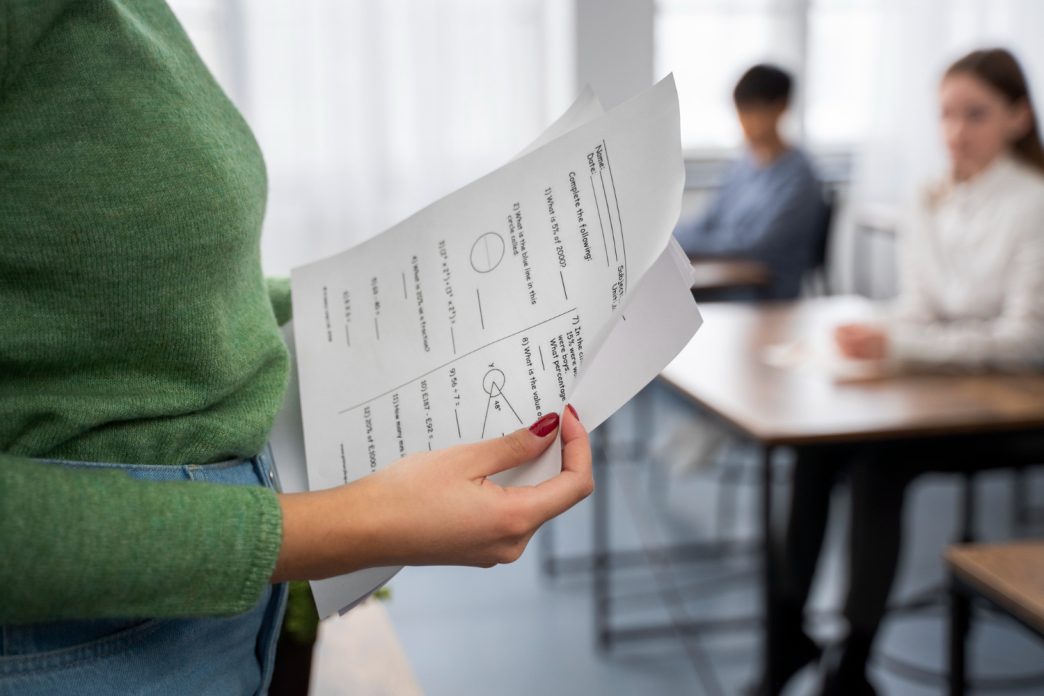
What is the PISA test?
PISA (Program for International Student Assessment) is the largest and most widely recognized international student assessment, designed to evaluate the performance of national education systems. Since 2000, every three years, the Organization for Economic Co-operation and Development (OECD) has tested more than 600,000 fifteen-year-olds from over 80 countries.
Unlike traditional school tests, which mainly assess how much content a student has memorized, PISA focuses on functional literacy, the ability to apply knowledge in real-life situations. In other words, it does not ask “what have you memorized,” but rather “can you use what you know when facing problems outside of school.”
The test covers three main domains: mathematics, reading, and science. Tasks are designed to reflect real-world situations rather than abstract, purely academic problems. A student might be asked to calculate materials needed for a practical task, interpret a scientific text, or analyze arguments in a news article.
In this way, PISA does not measure school knowledge alone, but what remains of it once textbooks are closed, the ability to think critically and solve everyday problems. 
Testing is conducted on a carefully selected, representative sample of approximately 5,000 to 10,000 students per country. Results are reported on a common scale, with the OECD average around 480–500 points, allowing comparisons across national education systems.
How do Serbia and the United States rank?
The 2022 PISA results are not encouraging for Serbia. Serbian fifteen-year-olds scored between 440 and 447 points on average across mathematics, reading, and science, significantly below the OECD average of 472 to 485 points. Globally, Serbia ranked around 40th place, alongside countries still dealing with the consequences of transition and less effective education reforms.
In comparison, the United States, one of the world’s most developed economies, achieved results slightly above average: 465 in mathematics (slightly below the OECD average), 504 in reading, and 499 in science.
PISA and GDP – is there a correlation?
A common claim is that high PISA scores directly lead to economic growth and national prosperity. However, data and real-world evidence show that this relationship is much weaker and more complex than often presented.
There is only a weak positive correlation between average PISA scores and GDP per capita, far too weak for PISA to be considered a reliable predictor of economic success.
The United States is a clear example. Despite only moderate PISA results, it remains the world’s leading economy, with the most innovative companies, top-ranked universities, and major technological advancements. This demonstrates that economic strength can develop without top PISA performance.
Conversely, some countries achieve high PISA scores while remaining relatively poor or only moderately developed. This indicates that strong test results do not automatically translate into rapid economic growth or prosperity.

Ultimately, PISA is not a reliable predictor of either current or future economic success. Economic performance depends on many other factors: institutional quality, rule of law, market openness, entrepreneurial culture, geopolitical position, natural resources, and broader cultural context.
PISA can measure certain cognitive skills in fifteen-year-olds, but it cannot predict how they will behave in real economic systems, how creative or innovative they will be, or their willingness to take risks. For this reason, the tendency to overstate the importance of PISA results for economic outcomes is more a political narrative than a scientifically grounded conclusion.
Criticism of the PISA test
Although PISA is often presented as an objective and scientific measure of education quality, it has been subject to growing criticism from experts worldwide.
Many researchers point out that high scores may be questionable due to selective sampling. Instead of testing all fifteen-year-olds, countries may disproportionately include stronger schools, urban areas, and higher-performing students, while underrepresenting weaker schools and rural populations.
This raises a key question: do top-performing countries truly have better education systems overall, or does PISA primarily measure the “elite” segment of their students?
What PISA does not measure
Another major criticism is the narrow focus on only three domains, mathematics, reading, and science, while largely neglecting creativity and social skills.
PISA is also said to encourage “teaching to the test,” where schools adapt curricula and teaching methods primarily to improve rankings. Instead of fostering critical thinking, education systems risk becoming focused on producing students who perform well on standardized tests.

The statistical models behind PISA results are themselves contested. Critics argue that the complex mathematical methods used do not produce fully reliable or comparable rankings across countries.
Cultural bias is another concern. Test questions often reflect Western ways of thinking and everyday experiences, which may disadvantage students from different cultural backgrounds, even if they have similar abilities.
Translation also introduces problems. Even with careful translation into more than 80 languages, nuances and difficulty levels can shift, making cross-country comparisons less reliable.
In addition, students often lack motivation to take the test seriously, since results have no direct consequences for grades, school progression, or university admission. For this reason, PISA is considered a “low-stakes” test, which further affects the reliability of outcomes.
PISA results are also frequently used for political purposes, by governments and media to criticize education systems, justify reforms, reduce teacher autonomy, or promote standardized testing and private education.
Can a single test score predict an individual’s future?
Supporters of PISA often claim that strong results predict later success in life. In reality, the relationship is far more complex.
Although higher PISA scores are somewhat correlated with a greater likelihood of completing higher education, obtaining better jobs, or earning higher incomes, this relationship is far from strong. Many individuals with low PISA scores later achieve success due to motivation, family support, persistence, luck, or favorable circumstances.
Conversely, high scores do not guarantee career success. Many top-performing students do not go on to achieve notable outcomes.
PISA measures only a narrow set of cognitive skills at a single point in time. It does not account for emotional intelligence, creativity, perseverance, social networks, or other factors that often play a more decisive role in real life than test results.
PISA can provide some insight into students’ knowledge and skills, but its results have clear limitations and cannot be treated as a fully reliable measure of education quality or future success.
Due to methodological issues, cultural differences, translation challenges, and low student motivation, the results require careful interpretation.
Rather than being treated as definitive, PISA scores should be viewed as just one indicator among many, not as a final judgment on education systems or individual potential
Photos: Magnific