


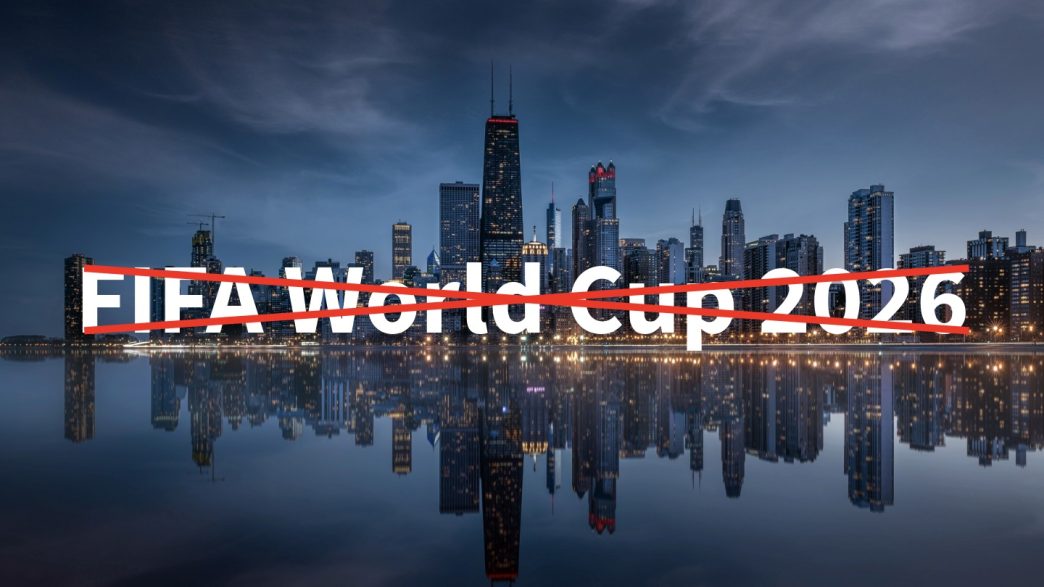
When discussing the biggest media, marketing, and sports markets in the United States, Chicago is always near the very top. And yet, when the 2026 World Cup begins, the Windy City will not be among the host cities. New York, Los Angeles, Dallas, Houston, Washington, Miami, Philadelphia, Atlanta, and others are on the list, but Chicago is not. That is precisely why one question has remained for years: how is it possible for such a large and sports-important city to be left out of the World Cup?
The answer takes us back to 2018, when then-Chicago mayor Rahm Emanuel made a decision that set him apart from many politicians across America. While numerous cities were fighting for a place in the joint bid of the United States, Canada, and Mexico, Chicago decided to withdraw. Formally, the city rejected FIFA’s terms. In practice, that meant Chicago lost its chance to become one of the hosts of the World Cup.
Chicago looked like an ideal host
On paper, very few cities could compete with Chicago. It is the third-largest city in the United States, extremely well connected to the rest of the country, and logistically very well positioned for a tournament that will be played across 16 cities in three countries. Chicago has Soldier Field, a stadium with major history, which had already hosted matches at the 1994 men’s World Cup, as well as games at the 1999 Women’s World Cup. The city has teams in all major American professional sports leagues and a public accustomed to the biggest events. That is why its withdrawal from the race, just three months before the joint bid’s final victory, came as a major surprise. 
Emanuel believed Chicago would take the risk while FIFA took the profit
The problem began the moment Emanuel carefully studied the contract FIFA was offering host cities. Under that model, world football’s governing body keeps the overwhelming majority of revenues from ticket sales, television rights, sponsorships, hospitality, and parking, while host cities take on the costs of public transportation, security, policing, medical services, firefighters, and the entire logistical operation.
Emanuel, who served as President Barack Obama’s chief of staff, put it very clearly:
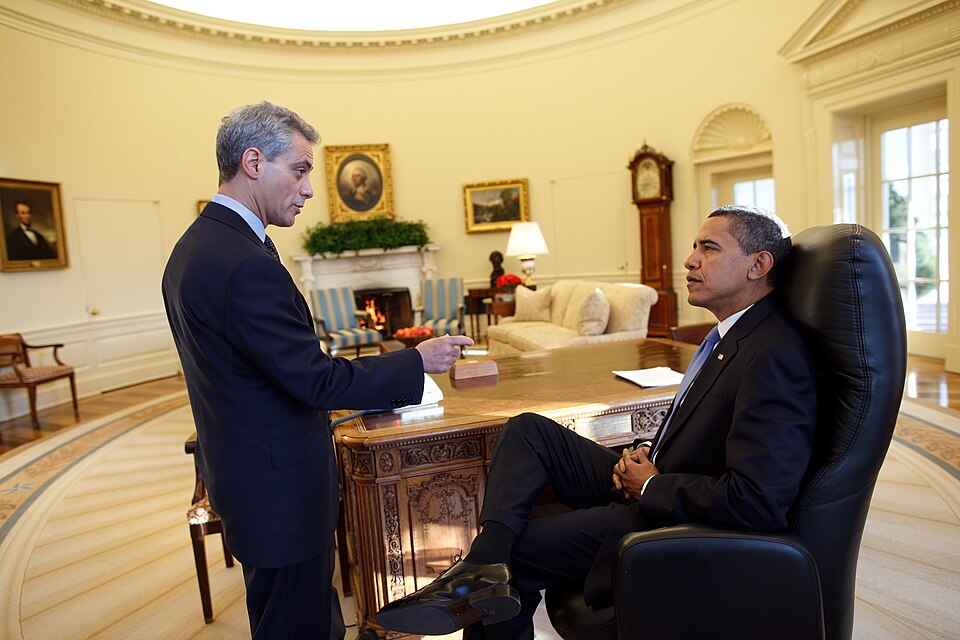
“We were on the front end of the bad side and the back end of the good side.” He then added: “I said, ‘I don’t know what other mayors or governors are doing, but do you really expect me to treat Chicago taxpayers like the suckers at the table? You’ve got to be kidding!’”
That is the core of his position. Chicago did not reject the World Cup because it did not want football. It rejected a deal in which the local community would carry all the obligations while FIFA would take the largest share of the benefits.
The roof over Soldier Field was the breaking point
One of the most disputed issues involved the possibility that FIFA could ask for a roof to be built over Soldier Field. By Emanuel’s estimate, such a move could have cost between $50 million and $100 million. For the mayor, that was unacceptable, not only because of the price, but because the city would have been exposed to a cost over which it would not have had the final say. What made the issue even more serious was the fact that Soldier Field has protected historic status, meaning that any major intervention would have required special approvals and an even more complex process.
Emanuel described it this way:
“They said in the contract that they had the right to request a dome being built over Soldier Field (the stadium is open). So I said: ‘You have got to take that out.’ They said: ‘We never use it, but we require everybody to put it in the contract.’ I said: ‘I don’t care that you’ve never used it. There’s always a first time. Take it out and then we can talk about the other issues.’ They said: ‘We can’t take it out.’ So I said there is not a chance I am going to let them dictate a $50 million to $100 million expense that taxpayers would have to pay. That was the straw that broke the camel’s back. You can’t have a provision that leaves the city and its residents exposed to risk while FIFA makes the decision and I don’t get a vote.”
Sponsors, transportation, Fan Fest, and taxes were also points of conflict
The roof was not the only problem. Chicago also had reservations about FIFA sponsorship rules, because host cities would have been restricted from working with companies FIFA might consider competitors to its own sponsors. In addition, there was an expectation that the city would fund free public transportation for ticket holders, as well as a free FIFA Fan Fest throughout the entire tournament. As was warned at one point, such a model could leave Chicago in debt.
Taxes were also a major issue. Emanuel claims that FIFA asked for exemptions from taxes on ticket sales during the tournament, something some states accepted in order to improve the chances of their cities. In Chicago, that was never going to happen. Emanuel had already refused to give tax concessions to local sports organizations and team owners, so he was not willing to make an exception for FIFA.
He spoke about that without hesitation:
“Cities and states who are sitting there throwing money at sports teams are out of their mind. We never did it. The idea that I would waive either an amusement tax or the sales tax for FIFA was a non-starter. Since I had already rejected those demands from local teams, if I had changed my position now, I would have created serious problems inside the city.”

“I can’t monetize marketing”
One of FIFA’s main arguments was that hosting would bring huge marketing value to Chicago. Emanuel did not accept that. He pointed out that the city had already hosted the NFL Draft in 2015 and 2016 and did not need FIFA in order to promote itself. In his view, marketing value was far too vague and impossible to measure to justify the concrete financial risk that would fall on residents.
That is why he said:
“I remember them saying: ‘This will be great marketing for the city.’ I said: ‘I don’t need you for marketing.’ We had the NFL Draft in 2015 and 2016! I said: ‘I don’t need you. Do you really think Chicago needs FIFA for promotion? Not happening.’ I can’t monetize marketing. I said: ‘You are taking cash and I’m getting some marketing benefit of undefined value?’ I simply said: ‘I don’t know who you normally talk to and negotiate with, but I’m not agreeing to that. That’s not a deal.’ I’m not the greatest business genius in the world, but I passed eighth-grade math and the numbers simply don’t work.”
He was not against sports, but against a bad deal
What makes this story even more important is the fact that Rahm Emanuel was not someone who avoided major sporting events. On the contrary, during his time in office Chicago brought in the NFL Draft, hosted the NHL Draft, landed NBA All-Star Weekend, and staged other major events. He wanted Chicago to be a world-class city for major sports events.
He himself stressed how suitable Chicago was for the World Cup:
“Because of the airport, the hotels, the capacity, and the fact that this is a city that does big things… along with our strong Eastern European, Central American, and Latino communities, this was a perfect city.”
That is exactly why his “no” to FIFA carried even more weight. He did not reject football. He rejected a model he believed was bad for the city and its residents.
Chicago technically signed the contract, but in a way that would make FIFA reject it
One of the strangest details in the whole story is that Chicago formally signed the contract, but did so in a way it knew FIFA would not accept. Since world football’s governing body did not allow changes to the document itself, Chicago signed a clean copy, but added an asterisk beneath the signature with a list of all disputed issues and conditions. That was a clear signal that the city was not prepared to enter the deal under the terms being offered.
Emanuel also described what followed:
“After that, there were one or two calls. They said: ‘What do you mean you’re done? Do you want to reconsider? What if we do this?’ We really did try to get to a deal. On the one hand, I wanted Chicago to be a world-class city for sports events. On the other hand, I had an obligation to a set of economic principles I was not willing to violate — not to let taxpayers be the suckers paying the bill. Those two desires were in conflict.”
No regrets, but no gloating either
Today, as the World Cup approaches, Emanuel says he does not wish anything bad on the host cities and hopes the tournament will be a success. There is, as he emphasizes, no “I told you so.” But at the same time, he makes it clear that he still believes Chicago did the right thing as a responsible guardian of the city’s future and taxpayer money.
As he said:
“I hope the tournament will be successful. I don’t wish anything bad on any mayor or governor. For many of them, this was agreed before they even took office. I hope the matches are great and that everyone succeeds. There is no ‘I told you so.’ But…”
Then he added the strongest point of the whole story:
“Do I think we did the right thing as responsible stewards of the city’s future and taxpayer dollars? Yes. If the average ticket price for the opening match is now $1,000, then average homeowners and renters are financially subsidizing an event for which they take all the risk, while they could never afford a ticket. Who agrees to a deal like that? If you live in Pilsen or Little Village, two predominantly Mexican-American communities in Chicago, you are expected to financially contribute to staging the match while not being able to afford to attend unless you take out a payday loan? Give me a break. No chance.”
That is the essence of the whole story. Chicago did not miss out on the World Cup because it did not want football. It missed out because it did not want ordinary residents paying the price for a spectacle that, in many cases, they would never be able to watch from the stands.
Source: Athletic, Meridian sport Photo: Wikimedia











.jpg#/media/File:P012109PS-0027_(3484808984).jpg)