



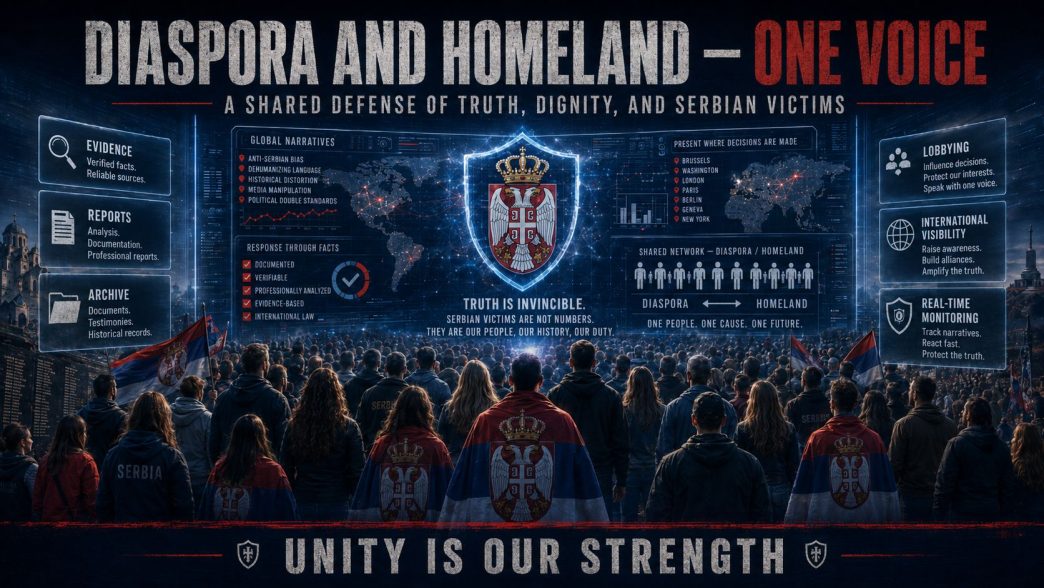
In the modern world, wars and attacks against a nation are no longer waged solely with weapons, but also through narratives. Whoever controls the story controls perception, and whoever controls perception controls political and social outcomes. That is why serious communities no longer leave their defense to chance or to individuals, but instead build systems that systematically monitor, document, and counter hatred, disinformation, and campaigns directed against them.
Serbs, who face persistent and often systematic Serbophobia, can no longer afford to remain disorganized and powerless. It is time to build our own defense – before the anti-Serb narrative becomes even more entrenched and dangerous.
How the Jews do it: a system that delivers results
The Anti-Defamation League (ADL), founded in 1913, is not just one of many NGOs, but an institution that has, over more than a century, established itself as a central coordinator in the fight against antisemitism. Each year, it publishes the “Audit of Antisemitic Incidents,” a report based on systematically collected and verified data on incidents ranging from verbal attacks and vandalism to organized campaigns of hate. These data do not remain confined to reports – they become the foundation for action: they are used in the media, influence public policy, and serve as leverage in communication with technology companies and government institutions.
A key strength of the ADL lies in the fact that it does not react after the fact, but tracks developments in real time. The H.E.A.T. Map is not merely a visual tool, but an analytical system that enables geographic and temporal tracking of incidents, identification of patterns, and forecasting of trends. In addition, the organization uses AI-based systems to monitor massive volumes of content on social media, gaining insight into how narratives spread, who initiates them, and where they have the greatest impact.
This is followed by concrete action – direct pressure on companies such as Meta, X, and TikTok to remove content that violates policies, as well as political pressure that leads to regulatory and policy changes. Both media and politicians are under constant scrutiny and pressure not to relativize or ignore the issue.
The anti-Serb narrative is not a thing of the past

Serbs are facing a similar, if not more aggressive campaign. In Kosovo and Metohija, an occupied part of Serbia, more than 200,000 Serbs have been ethnically cleansed since 1999. Attacks against Serbs in the north continue to this day – constant provocations, blockades, threats, and arrests.
In the region, Croatia tolerates or encourages Ustaša revisionism and the minimization of Serbian victims in Jasenovac, while in Bosnia and Herzegovina we continuously hear rhetoric about the “genocidal Serb.”
In Western media, Serbs are portrayed as perpetual aggressors and perpetrators, while Serbian victims are systematically ignored.
Around the world, attacks occur against Serbian churches, restaurants, and individuals; we see graffiti such as “Kill Serbs” and coordinated campaigns on social media.
The most insidious and often the loudest are Serbian self-denialists, foreign-paid actors, and so-called “useful idiots” who, for money or career advancement, spread falsehoods about their own people. This takes place on LinkedIn, Twitter, Facebook, TikTok, in tabloids, and in so-called “independent” media outlets.
These expressions of hatred are not spontaneous. They are part of an agenda aimed at keeping Serbs in a subordinate position through the concept of “collective guilt,” justifying ethnic cleansing, and preventing Serbia’s strengthening.
What needs to be done?
Citizens of Serbia and the Serbian diaspora must finally shift from a reactive to a proactive approach. What is needed is an independent and professionally organized institution, or a network of institutions, that will operate continuously and systematically.
Such a mechanism must record every incident without exception – from online abuse and coordinated campaigns to media manipulation and physical attacks against individuals and institutions. The source is irrelevant, whether external or internal – every case must be documented and archived.
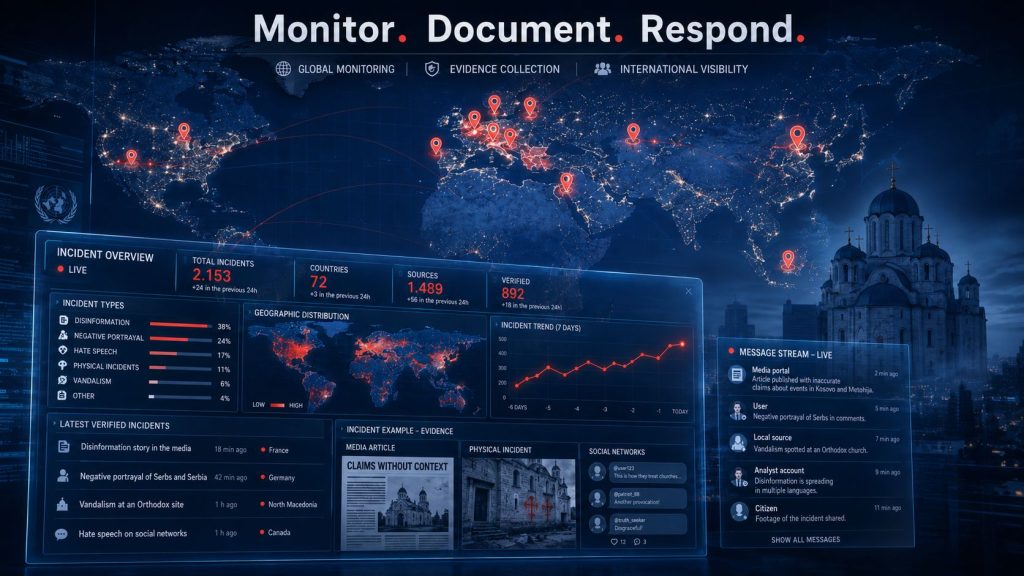
Modern tools, including artificial intelligence, enable real-time monitoring of vast amounts of data and online content, but the key lies in having a system capable of processing and storing that data.
At the same time, it is essential to publish regular and consistent annual reports, with clear statistics and concrete evidence. These reports must not be a formality, but a tool of influence – documents that will be cited in domestic and international media, institutions, and academic circles.
There must also be organized and continuous pressure on technology platforms to remove content that spreads hatred, following models that have already proven effective.
Without a presence on the international stage, no narrative can become relevant. That is why continuous lobbying in Brussels, Washington, and within international organizations is necessary – so that Serbian victims are finally recognized, revisionism is challenged, and the Serbian voice is heard where decisions are made. All of this requires significant financial and human resources, as well as political will. But the cost of inaction is far greater. Without such a system, Serbs remain unprotected in the digital world, exposed to narratives and interests imposed by others.
If we do not build our own defense today, tomorrow anti-Serb propaganda will become even stronger, and our victims will fall even further into oblivion. The time has come for Serbs to stand in defense of truth and dignity. The time for action is now.