

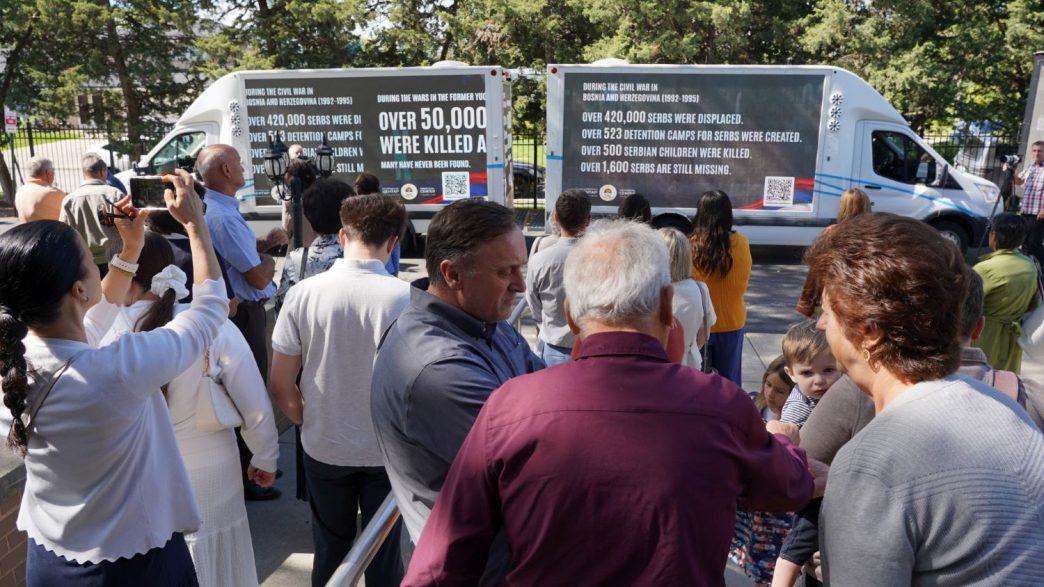
The multimedia exhibition “Learn About Serbian Suffering”, organized by the Memorial Center of Republika Srpska, was presented in Chicago on September 27, 2026, as Serbian Orthodox Christians marked the Feast of the Exaltation of the Holy Cross.
Its digital displays first appeared at several busy locations across the city before a separate presentation was held at Holy Resurrection Serbian Orthodox Cathedral following the Divine Hierarchical Liturgy.жFirst on Chicago Streets, Then at the Cathedral
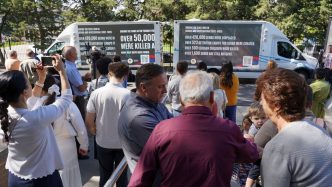
Digital materials, documents, testimonies, victims’ names and historical information were displayed on billboards mounted on specially equipped trucks at several locations around Chicago. Passersby stopped to photograph the displays and read the testimonies and names. Some also spoke with members of the Memorial Center team and shared their reactions.
The street presentation took the exhibition beyond spaces traditionally associated with Chicago’s Serbian community and brought it to people encountering its subject matter for the first time.
A separate part of the program was then held at Holy Resurrection Serbian Orthodox Cathedral, one of the city’s important gathering places for the Serbian community. The exhibition was presented to a large number of worshipers and community members following the Divine Hierarchical Liturgy.
Metropolitan Longin on the Cross and Historical Suffering
The Divine Hierarchical Liturgy, concelebrated by numerous clergy, was served by His Eminence Archbishop of New Gracanica and Chicago and Metropolitan of Midwestern America Longin.
In his sermon, Metropolitan Longin spoke about the meaning of the Cross and the historical suffering of the Serbian people, connecting that experience with the role of the Cross in the Orthodox Christian faith. He called on the faithful to carry their own life’s cross with humility and patience.
Bojić: The Serbian Story Should Be Visible Internationally
After the liturgy, Denis Bojić, director of the Memorial Center of Republika Srpska, addressed those in attendance. He stressed that the story of Serbian suffering should not remain confined to national and family circles, but should also reach international audiences and political circles.
Bojić said making Serbian suffering more visible outside Serbia and Republika Srpska could contribute to a broader understanding of developments in the Balkans and the position of the Serbian people.
He also stressed that the purpose of presenting these stories is not to promote revenge, but to preserve identity and the memory of individual victims and their lives.
Telić and Nikolić on Family Testimonies and Remembrance
Tatjana Telić, Consul of Republika Srpska in Chicago, and Dr. Marko Nikolić, Consul General of the Republic of Serbia in Chicago, also attended the exhibition and liturgy.
Telić said many Serbs living in Chicago carry personal and family testimonies of war and suffering. She emphasized the importance of giving them an opportunity to share those stories with the Memorial Center so they can be recorded and preserved.
Nikolić stressed the importance of discussing the subject in the United States, far from the places where the events occurred and before audiences that may know little or nothing about Serbian suffering.
He connected the suffering and sacrifices of the Serbian people with the preservation of national identity and emphasized the importance of maintaining and presenting a culture of remembrance both at home and internationally.
The “Learn About Serbian Suffering” campaign is being carried out in cooperation with the Republika Srpska Representative Office in the United States and the Republika Srpska Ministry for European Integration and International Cooperation. Before Chicago, the exhibition was presented in Washington, New York, Vienna and Rome.
The Government of Republika Srpska established the Memorial Center of Republika Srpska on May 30, 2024. Its mission focuses on preserving collective memory, research and education in the field of remembrance, with particular attention to victims of what the institution calls the Defense-Patriotic Wars from 1991 to 1999.