

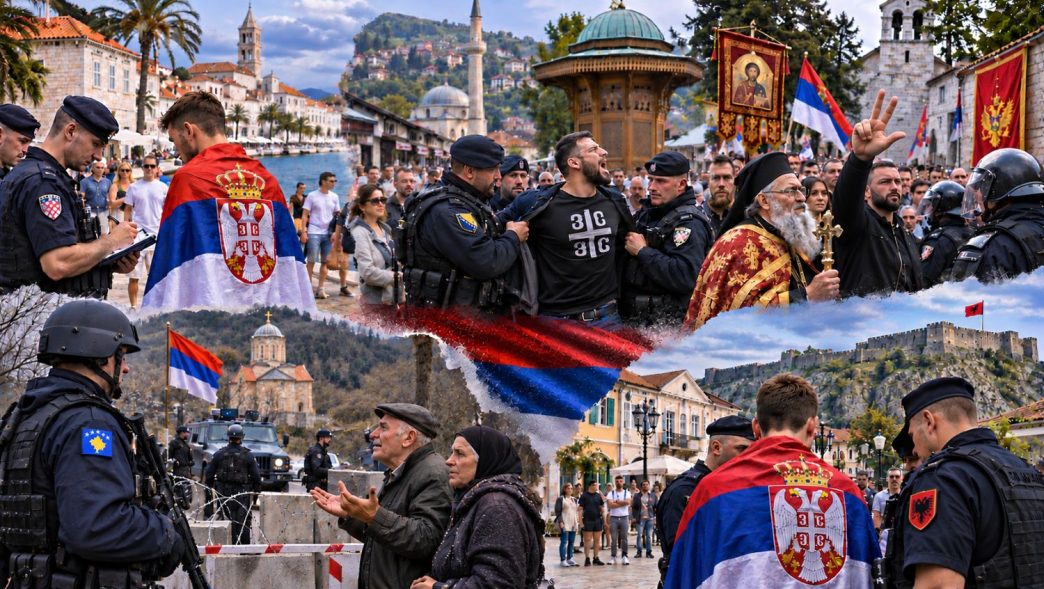
In some countries across the region, displaying the Serbian flag, raising three fingers, or showing a Cyrillic inscription can result in detention, a final court-imposed fine or prison sentence, deportation, or even physical assault. This raises the question of how acceptable it is in these places to openly identify as Serbian.
Let’s take a closer look.
Republic of Croatia
A Serbian citizen identified by the initials H. B., born in 2002, was fined €700 by the Municipal Court in Zadar on September 2, 2025, for disturbing public order and peace. She had posted a photograph on Instagram taken in Preko on the island of Ugljan, showing herself raising three fingers, with the caption: “Three fingers mean a fine, deportation, and a ban on entering the EU.” The court found that her actions had offended the national sentiments of Croatian citizens.
Š. F., born in 1997 and a citizen of both Croatia and Serbia, was fined €700 by the Municipal Court in Vukovar on September 5, 2026, over a photograph of a Serbian flag bearing the Cyrillic inscription “Vukovar” on his Facebook profile. He had originally posted the photograph, taken at a Serbia–Croatia soccer match in Belgrade, in 2013. The court found that keeping the image publicly accessible on his profile constituted a disturbance of public order and peace. Š. F. deleted the post during the proceedings.
Cases on Hvar and in Split
On the island of Hvar in July 2025, a 22-year-old Serbian citizen, whose name and initials were not released, faced misdemeanor proceedings over a photograph showing him standing on a motorcycle and raising three fingers with both hands. Police proposed a €700 fine, and an order was also issued for his deportation and a ban on entering or staying in the European Union.
Red Star Belgrade water polo players were attacked on Split’s waterfront promenade, known as the Riva, on February 9, 2019, after the attackers noticed their club insignia on their clothing. The attackers demanded that the players remove their clothes and then began beating them. Goalkeeper Aleksandro Kralj escaped by jumping into the sea. Police filed criminal complaints against the suspects for attempted infliction of serious bodily injury and robbery, with the offenses classified as hate-motivated.
Bosnia and Herzegovina
On September 6, 2022, the Basketball Association of Republika Srpska requested disciplinary proceedings against Jasna Sliško, head coach of Bosnia and Herzegovina’s women’s under-14 national team, over her treatment of two underage players identified as M. B. and T. G. According to the association’s statement, the girls were prohibited from celebrating three-point baskets by raising three fingers. They were also allegedly subjected to threats, including “We’ll cut off the hand of anyone who raises three fingers,” and harassment based on their ethnicity.
Sliško publicly confirmed that she had banned the three-finger gesture, which she described as a nationalist salute, but denied allegations of threats and mistreatment. Speaking about respect for Bosnia and Herzegovina’s flag and anthem, she said: “If you don’t like it, there’s the door.”
Incidents in Sarajevo, Goražde, and Konjic
A minor identified as V. V. and his mother, S. V., were attacked near the SCC shopping center in Sarajevo on May 23, 2024, because the boy was wearing a shirt bearing the words “Delije Sever,” referring to Red Star Belgrade supporters. The boy’s shirt was forcibly removed, while his mother was pushed and injured her knees and palms when she fell. According to her account, the attackers threatened the boy, saying, “Take off that Chetnik shirt,” and “I’ll kill you.” Police identified a 23-year-old suspect, and the prosecutor classified the incident as violent behavior.
A man from Inđija, whose name and initials were not released, received a misdemeanor citation in Goražde on May 9, 2026, for showing three fingers from a car. Police acted on a report that individuals in a vehicle with Serbian license plates had displayed the gesture on Kulin Ban Street the previous day. The passenger admitted to the misdemeanor, which police classified as offending the national and religious sentiments of citizens. The amount of the fine was not disclosed.
Four men from Užice were detained in Goražde in September 2026 after displaying three fingers through the windows of their car. All four received misdemeanor citations for offending religious and national sentiments and were subsequently held in police detention facilities.
Flag Dispute at a Church in Konjic
A group of citizens gathered outside the Serbian Orthodox Church of St. Basil the Great in Konjic on January 9, 2024, demanding that a tricolor flag be removed from the church flagpole. The gathering followed social media calls to pressure the church into taking down the flag. Police arrived at the scene, and church personnel removed the flag, after which the crowd dispersed.
Republic of Montenegro
During vehicle processions held in July and August 2020, police in Nikšić announced that four people had faced misdemeanor proceedings for displaying Serbian flags on August 2. Another 13 people were identified in connection with flag displays on July 26.
Kosovo and Metohija – Serbia’s Occupied Southern Province
In Sočanica on August 18, 2026, a 15-year-old identified as M. I. was taken to a police station because he was wearing a T-shirt bearing the inscription “Serbian Kosovo and Metohija.” According to the police description, the shirt also featured an emblem of the Special Operations Unit (JSO), a wolf superimposed on a map of Kosovo in the colors of the Serbian flag, and a Serbian flag on the sleeve. Police confirmed that the T-shirt was the reason for the initial stop and that misdemeanor proceedings had been initiated against the minor for disturbing public order and peace.
In a November 2025 report, the European Union Rule of Law Mission in Kosovo (EULEX) documented several cases in which minors, whose identities were not disclosed, were briefly deprived of their liberty and questioned for wearing shirts displaying national symbols or for painting graffiti. Some received misdemeanor fines. The mission concluded that such treatment of children violated international children’s rights standards and so-called Kosovo regulations, and that the intention to threaten public peace had not been clearly established in the monitored cases.
Attacks in Gojbulja and Leposavić
Thirteen-year-old Nikola Perić was attacked on July 1, 2021, in Gojbulja, near Vučitrn, while returning home from playing soccer. According to the Serbian government’s Office for Kosovo and Metohija, the attackers knocked him to the ground, beat him, and tore a small cross from his neck. The boy was taken to a hospital in Kosovska Mitrovica with bruises and other contusions, and the incident was reported to the so-called Kosovo Police.
According to records maintained by the Office for Kosovo and Metohija, 18-year-old Vojin Milojević was intercepted in Leposavić on March 3, 2026, by members of the so-called Kosovo Police, forced into a vehicle, and beaten because he was wearing a T-shirt with the inscription “With Faith in God, Kosovo Is Serbia.”
Republic of Albania
Vladislav Dajković, president of Free Montenegro, was sentenced at first instance in June 2026 to three years in prison for “inciting national hatred and discord.” The sentence was reduced to two years. The proceedings stemmed from a photograph taken and posted on social media six years earlier, showing him holding a tricolor flag in Shkodër alongside the message: “Greetings to everyone from the ancient Serbian city of Shkodër.”
Photo: ChatGPT