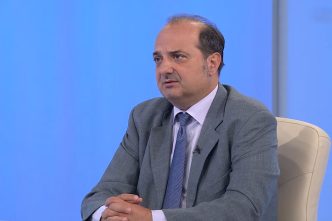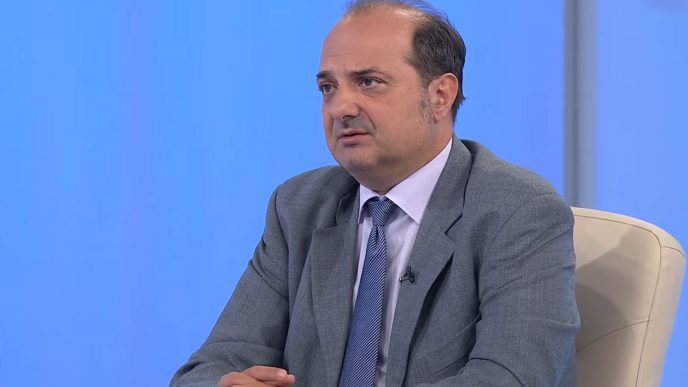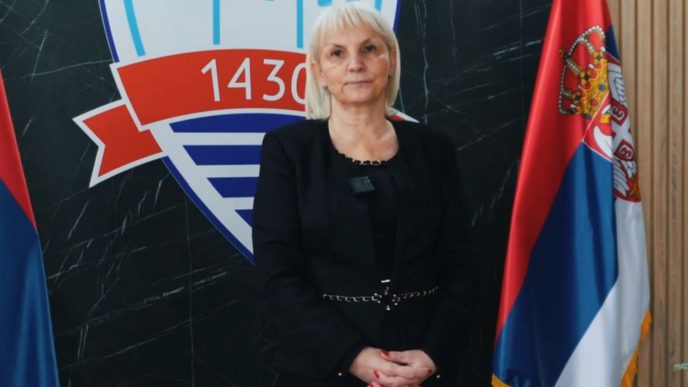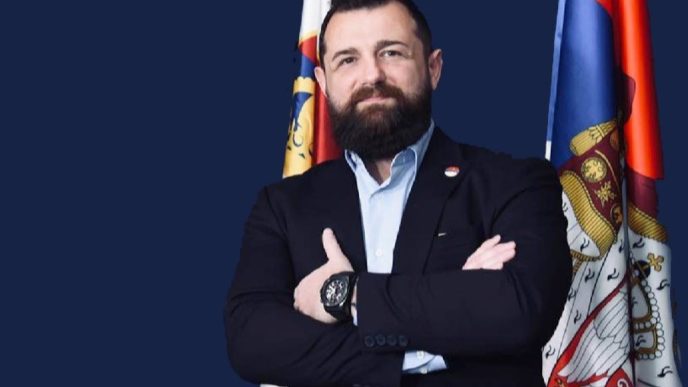


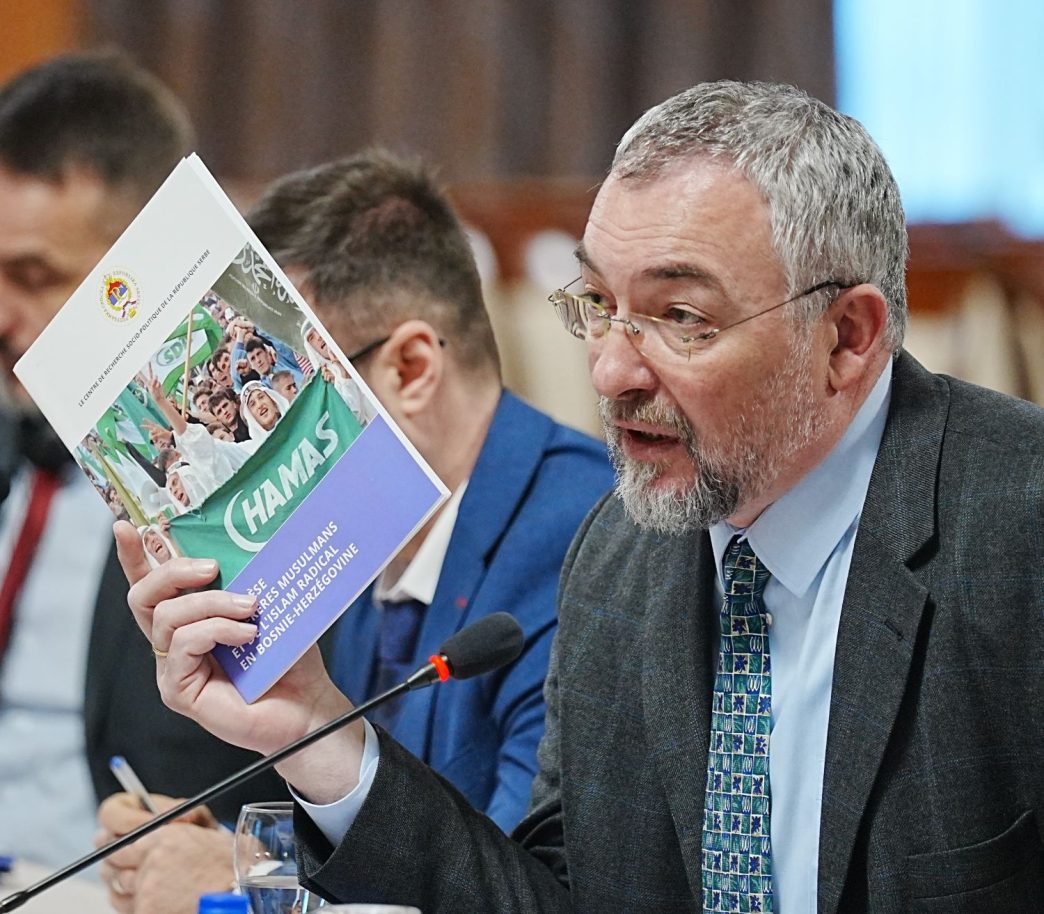
Dušan Pavlović, director of the Republika Srpska Center for Socio-Political Research, has spent more than two decades researching the wartime suffering of Serbs in the twentieth century. He holds a master’s degree in theology and is a doctoral candidate at the University of Banja Luka’s Faculty of Political Sciences.
He was certified by Yad Vashem in Israel to teach Holocaust history. At the Missing Persons Institute of Bosnia and Herzegovina, he headed the Search, Exhumation, and Identification Division. He is the author of two books, The Battle for Srebrenica: A War for Civilization and The Genocide of Serbs in the Independent State of Croatia: A People Who Were Not Meant to Exist.
How did the Muslim Brotherhood’s ideas make their way from Egypt to Bosnia and Herzegovina, and what ties did the Young Muslims have to Chicago? In an interview with Chicago na dlanu, Pavlović discusses political Islam in Bosnia and Herzegovina, from Alija Izetbegović’s Islamic Declaration and the role of the Party of Democratic Action (SDA) to the influence of Turkey and Iran and recruitment for radical Islamist organizations in Syria and Iraq.
Pavlović also discusses testimony from Serbs held in detention in wartime Sarajevo and an archive documenting the destruction and desecration of Serbian Orthodox churches, cemeteries, and holy sites in Bosnia and Herzegovina. He explains why it is important for the Serbian diaspora to bring these events to the attention of American universities, media outlets, members of Congress, and the wider American public.
What did your research find about the history of political Islam in Bosnia and Herzegovina, and what do you mean by the term?
The main finding is that political Islam in Bosnia and Herzegovina has a history, identifiable proponents, and forms of organization that predate the war of the 1990s, and that it has been present in this region for nearly a century. At the same time, it is important to emphasize that traditional Islam, the faith of our fellow citizens, is part of the region’s historical and religious life. Freedom of religion and equality of religious communities before the law are constitutional obligations of Republika Srpska, as well as part of our civilizational heritage.
By political Islam, we mean projects that seek to organize society and the state according to a particular interpretation of Islamic norms. That means establishing a social order based on Sharia as the supreme legal document governing the state and society, thereby excluding democratic government and equality for all. This encompasses a range of movements and methods, including calls for violence and terrorist activity.
How does your study trace the influence of the Muslim Brotherhood’s ideas, and what role do you attribute to the SDA and the Patriotic League?
In the publication and the documentary, we trace the spread of the Muslim Brotherhood’s ideas from Egypt to what is now Bosnia and Herzegovina in the first half of the twentieth century, their resonance among the Young Muslims during and after World War II, Izetbegović’s Islamic Declaration, the formation of the Party of Democratic Action (SDA) as the political wing of this ideology, and the building of ties with global pan-Islamist and terrorist networks to establish an Islamic state in Europe, in Bosnia and Herzegovina.
This publication is only one part of our research into the phenomenon. Our conclusion is that within that ideological core of the SDA and the so-called Army of the Republic of Bosnia and Herzegovina (ARBiH), there was a project to establish an Islamic social and political order.
In our reconstruction, we see the SDA as the main political instrument and the party-affiliated Patriotic League as the instrument for military organization during the preparatory phase, which began with the League’s founding as early as April 1991. A year later, at the outbreak of the civil war in Bosnia and Herzegovina, the Patriotic League, as the official military wing of the SDA, made up the bulk of the so-called ARBiH, both among its officers and in its ranks generally.
We look in particular at the reorganization of the Islamic Community in 1993 and the appointment of Mustafa Cerić, one of the founders of the SDA, as its head, or reis. Our assessment is that bringing political and religious authority together enabled that ideological circle of the Muslim Brotherhood to present its model of political Islam as binding on a much wider Muslim community in Bosnia and Herzegovina and across the region.
Which parts of the Balkans do you identify as the main hotspots of Islamic radicalization? How do you assess the security risks in Bosnia and Herzegovina, Albania, and Kosovo and Metohija?
We see the most serious risk where propaganda that justifies violence comes together with people who have combat experience and the organizational capacity to recruit and raise funds. The religious makeup of a city or region is not necessarily a measure of that risk. A single active network may be more significant from a security standpoint than an entire area where Muslims go about their ordinary religious lives.
In the region, Bosnia and Herzegovina bears a particularly difficult legacy of foreign Islamic fighters arriving in the 1990s, international ties being established, and missionary activity after the war. The later departures of Muslims from Bosnia and Herzegovina to Syria and Iraq to join ISIL and various al-Qaeda affiliates showed that the region had become a place of more than religious preaching.
That is why it is important to track the continued activity of specific groups, returnees and their families, radicalization in prisons, and online networks. The Center studies the historical and sociopolitical conditions behind this process, while current operational assessments are the responsibility of the relevant agencies.
As has been publicly reported, recruitment, departures to foreign war zones, and court proceedings over terrorist activity have also been documented in Kosovo and Metohija and in Albania. There, too, it is important to distinguish religious life, national politics, and jihadist networks. This raises, first and foremost, the question of the responsibility of the relevant institutions and the political forces in power.
A decline in the number of people leaving to fight in Islamist conflicts abroad does not in itself prove that radicalization has ended. The activity can take other forms and move to other platforms while pursuing the same goals.
What is known for certain about recruitment for terrorist organizations in Novi Pazar and the Raška region?
Given the Center’s mandate, we do not have that kind of information. Publicly available records show that specific groups recruited people for terrorist organizations and arranged for them to go to Syria to fight. Public records document the final convictions of seven people, upheld in Belgrade in 2019, in a case involving terrorist association, recruitment, and, for some of those convicted, financing terrorism.
How do you interpret the attacks on security personnel at the Israeli Embassy in Belgrade?
The first attack took place on June 29, 2024. Miloš Žujović, who lived in Novi Pazar and had evidently joined Islamist groups, shouted “Allahu akbar” and seriously wounded a gendarme with a crossbow. The officer returned fire and killed the attacker. Serbia’s official national risk assessment stated that the attacker was a radicalized individual who supported the Islamic State terrorist organization.
The second attack took place on October 28, 2026. According to the official statement, the underage attacker, who was said at the time to be from Šabac, used knives to attack a member of the Israeli Embassy’s security detail. The security officer sustained minor injuries, and the attacker was killed in self-defense. The interior minister said that the security services had been monitoring the attacker and that he was a supporter of the Islamic State and had posted its symbols on social media.
In our interpretation, the choice of the Israeli diplomatic mission as a target, together with the publicly released information about support for the Islamic State, shows how global jihadist propaganda can direct violence at the local level.
How much can public information tell us about the work of Serbia’s security services, and what matters in preventing recruitment?
I cannot assess the capabilities of Serbia’s security services, simply because the Center has neither the mandate nor the expertise to do so and, as a research institution, has no access to their records. Public proceedings show that there is a capacity to detect and prosecute these offenses.
What is needed is sustained institutional work based on evidence and a clear division of responsibilities.
In the long term, it is important that parents, schools, and responsible religious authorities be able to turn to the relevant institutions before a problem escalates into a criminal offense. Reporting recruitment should be a way to protect children and the community. We have seen cases in which young Orthodox Serbs were also victims of Islamist recruitment. Recklessly stigmatizing an entire community helps the very people who tell young people they have been rejected simply because they are Muslim. We know that Islamists exploit that sectarian approach to the fullest.
How do you interpret the decision of the 1993 Bosniak Assembly and the Islamic Community’s treatment of Fikret Abdić’s supporters?
Alongside violent groups, we study the broader political landscape and questions of identity. For example, the Bosniak Assembly held in Sarajevo on September 27 and 28, 1993, was organized and controlled by the Muslim Brotherhood through the SDA, the so-called ARBiH, and the leadership of the Islamic Community of Bosnia and Herzegovina. It adopted a declaration on the Bosniak national name, under which Muslims as a nation would change their name to Bosniaks.
In our view, the political and religious circles around the leadership at the time saw the link between religion and that national project as a means of mobilization that extended beyond the borders of Bosnia and Herzegovina. This is particularly important for understanding relations with Muslim communities in Serbia, Montenegro, and other countries that emerged from the breakup of Yugoslavia.
Another case of interest is that of the traditional Muslims of northwestern Bosnia and Herzegovina, led by Fikret Abdić, who refused to accept this model of political Islam.
Immediately after the SDA made the political decision at the Holiday Inn in September 1993 to declare Muslims Bosniaks, the Islamic Community of Bosnia and Herzegovina issued an official fatwa declaring these members of the Muslim people in Western Bosnia unbelievers. This is considered the gravest form of apostasy from Islam.
Members of the armed forces of this province in Bosnia and Herzegovina were officially denied a janazah, the Islamic funeral rite. The official reason given was that by taking up arms against the so-called ARBiH, they were fighting against Islam. The same fatwa emphasized that members of the so-called ARBiH who fell in battle would be granted the status of shaheeds, or martyrs, because they had died in the path of Allah!
This example carries particular weight given that the fatwa was officially and formally revoked only in 2013, by the Fatwa Council of the Riyasat of the Islamic Community of Bosnia and Herzegovina.
How do you assess Turkey’s political influence in Bosnia and Herzegovina and the Balkans?
Here I would single out Iran and Turkey in particular. Turkey and Iran exert influence in the Balkans on different historical foundations, through different means, and with different goals.
In Turkey’s case, public statements show how the Ottoman legacy is tied to contemporary state policy. It is worth quoting the exact words of former Turkish Prime Minister Ahmet Davutoğlu in his official address at the reopening of the restored Turkish Ferhadija Mosque in Banja Luka on May 7, 2016. “We were here, we are here, and we will be here for eternity.”
Even more significant for the political interpretation is the speech he gave before leaving for Bosnia and Herzegovina. Davutoğlu used the term evlad-ı fatihan, meaning “descendants of the conquerors,” linking the Muslims of Bosnia and Herzegovina to the Ottoman legacy. He presented the restoration of the Ferhadija Mosque as a renewal of that legacy in the Balkans and as a symbol that embodied the essence, philosophy, and foundation of his policy. In this context, Turkey’s intention to tap the potential of Bosniaks in Bosnia and Herzegovina and across the region to act as its proxy is apparent.
Which sources document Iran’s military and intelligence presence in Bosnia and Herzegovina, and how did Iranian influence manifest itself after the war?
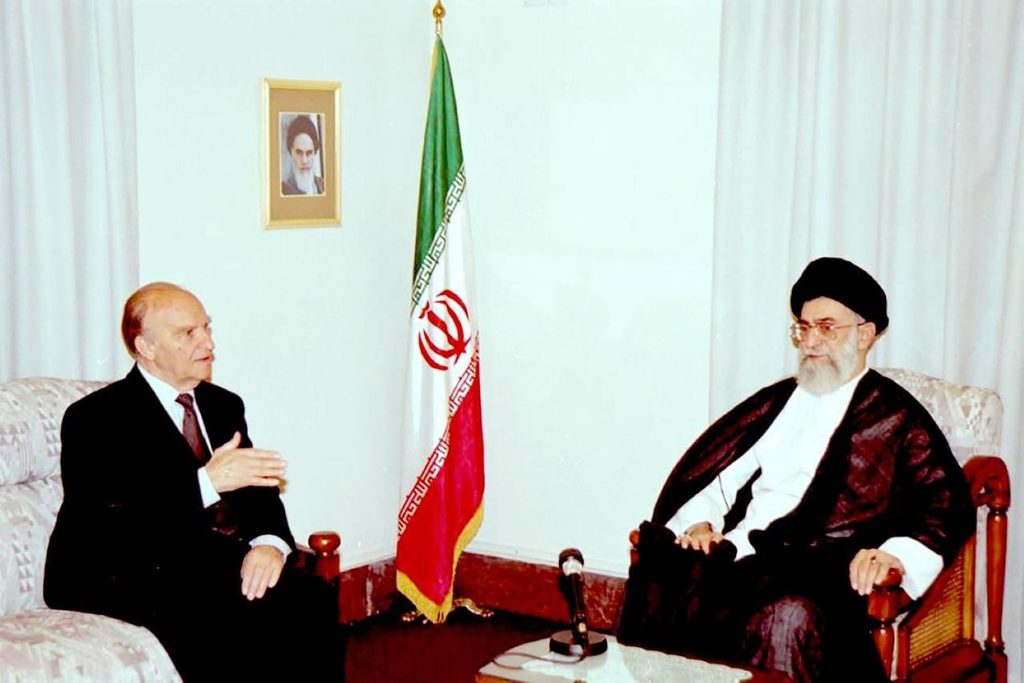
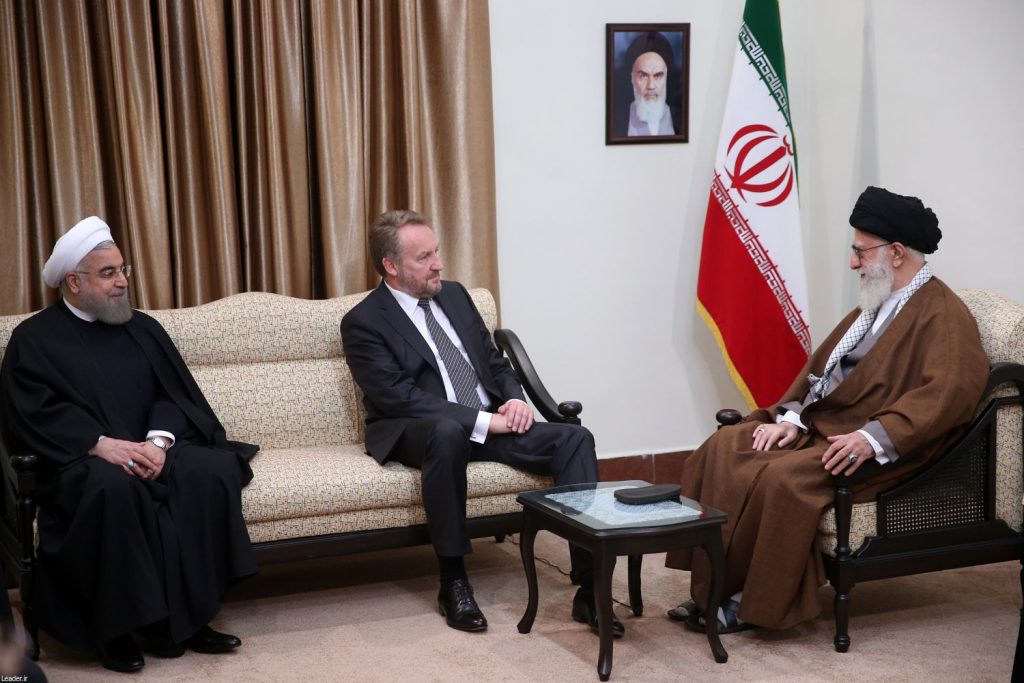
In Iran’s case, the military and intelligence dimension is more clearly documented during the war and immediately afterward. Ties with Alija Izetbegović were being established even before the war in Bosnia and Herzegovina began. In his diary entry for May 6, 1991, President Rafsanjani records that Izetbegović asked for light weapons and helicopters, that he agreed, and that he instructed his defense minister to help. This is the account of the Iranian president at the time, describing a request for military assistance made nearly a year before the war in Bosnia and Herzegovina broke out.
There are also official U.S. records for the wartime period. A November 1996 report by the U.S. Senate Intelligence Committee examines in detail Iranian arms shipments to the Bosnian army through Croatia in 1994 and 1995, as well as how the United States handled those shipments.
The case of Pogorelica, near Fojnica, provides even more direct evidence of security cooperation. In its report on global terrorism for 1996, the State Department states that on February 15 of that year, IFOR raided a joint Bosnian-Iranian intelligence training center and detained eleven people, including three Iranians. According to the report’s assessment, the evidence found indicated that some of the training covered terrorist tactics.
There are also clearly visible postwar channels for Iran’s cultural and intellectual presence. The Ibn Sina Institute, founded with Iranian support in 1997, became formally affiliated with the University of Sarajevo on February 14, 1998. The Mulla Sadra Foundation says it officially began operating in Bosnia and Herzegovina in 2003 and specifically highlights its cooperation and coordination with the Riyasat of the Islamic Community of Bosnia and Herzegovina.
What measures have been proposed or adopted in Bosnia and Herzegovina, Egypt, and the United States concerning the Muslim Brotherhood and organizations linked to it?
There is a specific example from this year. In April, Ms. Željka Cvijanović, the Serb member and chair of the Presidency of Bosnia and Herzegovina, twice put forward an initiative to designate the Muslim Brotherhood as a terrorist organization. According to published reports, the proposal was left off the Presidency’s agenda on April 2, and on April 29 Denis Bećirović and Željko Komšić rejected the initiative.
Egypt’s recent decision is also significant. According to a November 10, 2026, report by the state news agency MENA, a ruling by the Cairo Criminal Court placed 35 organizations and 36 individuals on lists of terrorist entities and terrorists for five years. The organizations include the Council of European Muslims and AKOS from Bosnia and Herzegovina.
The U.S. decision of January 13, 2026, also covered the Egyptian, Jordanian, and Lebanese branches of the Muslim Brotherhood, with different legal designations, since each measure must identify the organization, the activities that have been proven, and the authority with jurisdiction. Analyzing political Islam, banning an organization’s activities, and determining criminal liability are separate processes.
Which positions in Alija Izetbegović’s Islamic Declaration do you highlight in your analysis?
It is extremely important to read and closely analyze the texts that set out the programs of such groups. Alija Izetbegović’s Islamic Declaration, for example, states explicitly, “There is no peace or coexistence between the ‘Islamic faith’ and non-Islamic social and political institutions.” Elsewhere, establishing an Islamic order in society and the state is described as “an inviolable objective that cannot be voted down.”
In the section on the means of influencing the public at large, Izetbegović insists that they be in the hands of people of undisputed Islamic moral and intellectual authority. He asks, “What can we expect if the mosque and the television tower send the people completely contradictory messages?” These are specific provisions about the relationship between religion, government, and public life.
Alija Izetbegović’s pan-Islamist objective is also explicit in the manifesto. It calls for the creation of a large Islamic federation from Morocco to Indonesia and for the gradual formation of supranational economic, cultural, and political structures. In this program, education, publishing, and the building of ties among organizations are meant to lay the groundwork for a broader transformation. For non-Muslim minorities, the program provides for the status of a loyal minority rather than equality guaranteed by a democratic constitution.
What ties did members of the Young Muslims have with Muslim institutions in Chicago and with publishers in North America?
The circle of Muslim émigrés from Yugoslavia in Chicago is also important to this subject. Nurko Gazija, a member of the Young Muslims, moved to Chicago in 1950 and helped found the Muslim Religious and Cultural Home in 1955. Galib Hadžić, also a member of this pan-Islamist organization, served there as imam and head of religious education from 1963 to 1965. Ćamil Avdić and Seid Karić were also important figures in the institution’s history.
Alija Izetbegović’s Islam Between East and West, a book with cult status in pan-Islamist circles worldwide, was published in English in 1984 by American Trust Publications (ATP). Hasan Karačić, also known as Hasan Karachi, a member of the Young Muslims and an émigré from the Independent State of Croatia who was living in Canada, helped get the book published and wrote the preface. Smail Balić wrote the introduction. The North American Islamic Trust (NAIT) identifies ATP as its publishing arm and links its own founding to the Muslim Students Association (MSA).
What parallels do you see between the Islamic Declaration and the memorandum addressed to the Muslim Brotherhood’s leadership in North America?
The May 22, 1991, memorandum by Muhammad Akram, also known as El-Adlouni, should be mentioned here. It was addressed to the Muslim Brotherhood’s leadership in North America and was later introduced as an exhibit in the U.S. Holy Land Foundation case. The author calls the process “civilizational jihad” and speaks of destroying Western civilization from within.
He proposes strengthening organizations, forming coalitions, and pooling resources. In an appendix, he lists ATP, NAIT, MSA, the Islamic Society of North America (ISNA), and the Association of Muslim Social Scientists (AMSS) among the Brotherhood’s own organizations and those friendly to it.
I also see parallels between this document and Alija Izetbegović’s Islamic Declaration in the gradual pan-Islamist method of shaping individuals and developing cadres, building organizational infrastructure and entering institutions, Islamizing knowledge, and establishing a Sharia order across national borders worldwide.
Which sources do you consider particularly important for researching the suffering of Serbs in wartime Sarajevo and the destruction of Orthodox holy sites in Bosnia and Herzegovina?
It is particularly important to link the analysis of ideology to people’s documented experiences. Our interpretation concerns the continuity of ideas and personnel between the Young Muslims and the SDA’s core leadership, and the affinity of that leadership with the political project of the Muslim Brotherhood. The question is how that program translated into party control of institutions and what the consequences were for citizens who were outside that project.
The fate of Serbs in the part of wartime Sarajevo controlled by the authorities of the Republic of Bosnia and Herzegovina is an important case for research. The report of the International Commission for Research on the Suffering of Serbs in Sarajevo, 1991–1995, examines the suffering and destruction of the city’s historic Christian Serb community.
At incomfis-sarajevo.org/mapping, there is a preliminary list of more than 200 camps, prisons, detention centers, and other sites where Christian Serbs were held. This material, based on the testimony of victims, allows us to discuss the nature of the SDA’s ideology and the implementation of the Islamic Declaration as a political manifesto. The responsibility of the political, police, and military structures continues to be ignored internationally and is largely denied in the Muslim part of Bosnia and Herzegovina.
Another important source worth mentioning is destroyedchristianity.org, a digital archive of Serbian Orthodox churches, cemeteries, and holy sites that have been destroyed, damaged, or desecrated. It primarily covers the postwar period and sites in the Federation of Bosnia and Herzegovina.
Demolishing churches and desecrating cemeteries are acts against civilization par excellence! That is why, in each such case, we need to examine what the Federation of Bosnia and Herzegovina has achieved in protecting these sites and prosecuting those responsible. There are dozens of such cases, perhaps hundreds.
Whenever a documented case has received no effective response, we should demand answers from the relevant authorities in the Federation of Bosnia and Herzegovina and from the institutions that monitor human rights, the return of displaced people, and religious freedom. A statement of condemnation leaves the questions of accountability and protection open.
What can the Serbian diaspora in the United States do to bring this material to the attention of the American public?
American professionals, academics, policymakers, and journalists should have access to these sources in English.
Our diaspora as a whole, and especially our community in America at this moment, has an exceptionally important role to play on this issue. All Serbs who are U.S. citizens have a clear patriotic, Christian, and civilizational duty to present and bear witness to the facts about the destruction of the historic Christian community in the Muslim part of wartime Sarajevo (https://incomfis-sarajevo.org/mapping/) and the systematic post-Dayton destruction of Serbian Orthodox churches, cemeteries, and holy sites in the part of Bosnia and Herzegovina controlled by Bosniak Muslims (https://www.destroyedchristianity.org/).
These materials can and must be sent to universities, professional organizations, media outlets, members of Congress, the relevant offices in the U.S. administration, and the U.S. Embassy in Bosnia and Herzegovina. Our young people should present them in schools and colleges!
Here in Republika Srpska, we gathered these materials and documented these facts under truly difficult conditions. It cost some of us court proceedings and persecution, including the president of Republika Srpska himself. The best proof of support for our overall struggle for survival and progress would be for our diaspora to actively present these materials to the audiences I have already mentioned.