

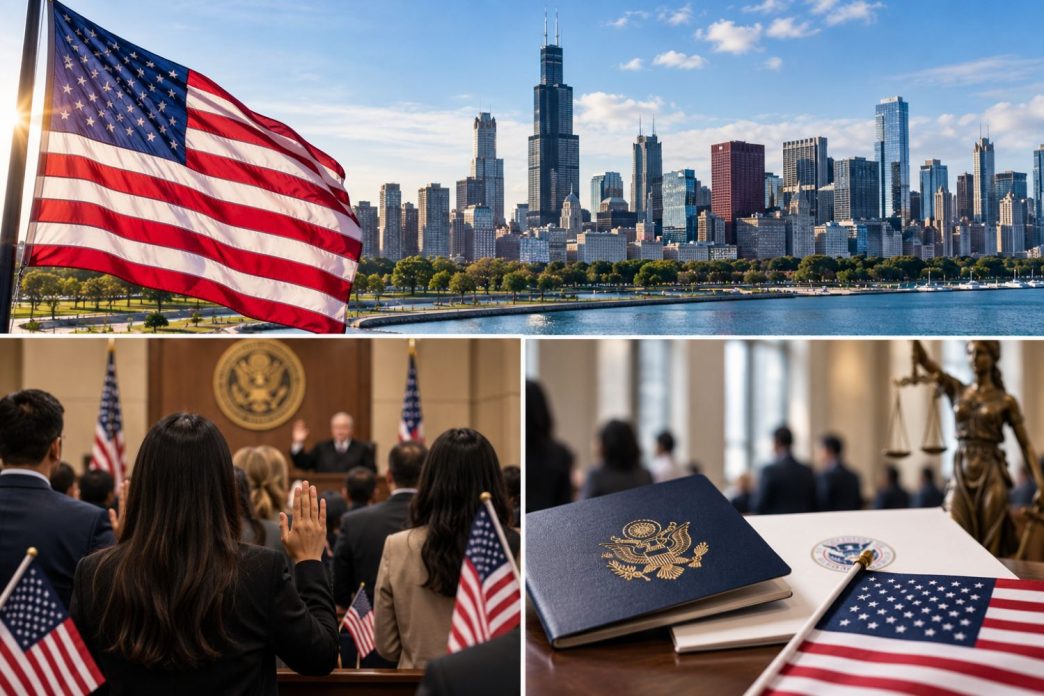
The number of people becoming U.S. citizens in Chicago has dropped sharply this year. According to the U.S. District Court for the Northern District of Illinois, fewer than 4,500 people became U.S. citizens during the first seven months of 2026. Over the same period during the previous four years, the average was 16,580. Compared with last year, the decline is more than 75%.
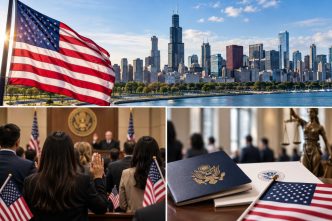
The change was also visible at a naturalization ceremony held August 18 at the Dirksen Federal Courthouse in downtown Chicago, where 97 people from 34 countries took the Oath of Allegiance. By comparison, nearly 1,000 people took the oath at Wrigley Field in August of last year.
The size of a single ceremony, of course, is not enough to draw conclusions about an entire year. Court data, however, show that this is not simply a matter of smaller ceremonies. The overall number of people becoming U.S. citizens in the region has fallen substantially.
What Has Changed Over the Past Year?
Several rules affecting the naturalization process have changed over the past year. One of the most significant involves the assessment of “good moral character,” which has long been a legal requirement for U.S. citizenship.
In August 2025, U.S. Citizenship and Immigration Services (USCIS) issued new guidance to its officers. When reviewing applications, officers are now instructed to take a broader look at an applicant’s conduct and circumstances rather than focusing primarily on whether the person has committed an offense or engaged in conduct that would legally prevent naturalization.
Factors that may be considered include family responsibilities, employment, payment of taxes, education, and ties to the community. Officers may also consider certain conduct that, by itself, would not automatically disqualify someone from becoming a U.S. citizen.
The good moral character requirement itself is not new. What has changed is how USCIS instructs its officers to evaluate that requirement when reviewing an application.
The Citizenship Test Is Now More Extensive
The civics portion of the naturalization test has also changed. The new version applies to applicants who filed Form N-400 on or after October 20, 2025.
Under the previous test, applicants studied 100 civics questions. During the interview, they were asked up to 10 questions and needed six correct answers to pass. The new test includes a pool of 128 questions. An officer may ask up to 20, and applicants must answer 12 correctly. The test ends once an applicant reaches either 12 correct answers or nine incorrect answers.
As a result, people applying for citizenship today face a more extensive civics test than those who went through the process under the previous rules.
Why Has the Number Fallen So Sharply?
Despite the decline of more than 75%, there is not yet enough evidence to identify a single cause. The new rules, increased scrutiny of applicants, and the drop in naturalizations have occurred during the same period, but that alone does not prove that the policy changes caused the decline.
The American Civil Liberties Union of Illinois (ACLU of Illinois) believes the decline is connected to the immigration policies of President Donald Trump’s administration. Edwin Yohnka, the organization’s director of communications and public policy, has argued that the lower number of people becoming citizens reflects a broader change in the federal government’s approach to immigration.
USCIS offers a different explanation. Agency spokesperson Zach Kahler said applicants are now being more thoroughly vetted and that there will be no shortcuts in the naturalization process. USCIS maintains that the current approach addresses shortcomings in the way applicants were screened under the previous administration.
What Does This Mean for Green Card Holders?
For green card holders who meet the requirements for U.S. citizenship, the option to apply remains unchanged, as do the basic eligibility requirements established by law. Applicants still file Form N-400, undergo background checks and an interview, and, in most cases, must demonstrate English proficiency and knowledge of U.S. history and government.
Some parts of the process, however, are different from what they were several years ago. Those considering applying for citizenship should therefore rely on current USCIS requirements rather than solely on the experiences of friends or relatives who became citizens under earlier rules.
The central question remains: Why has the number of people becoming U.S. citizens in Northern Illinois fallen by more than 75% in just one year? The number of people taking the Oath of Allegiance alone cannot answer that question. A clearer picture would require data on how many applications were filed, how many were processed and denied, and how long applicants are currently waiting for a decision. Only then will it be possible to determine more precisely what is driving such a significant decline.
Source: Capitol News Illinois, USCIS