

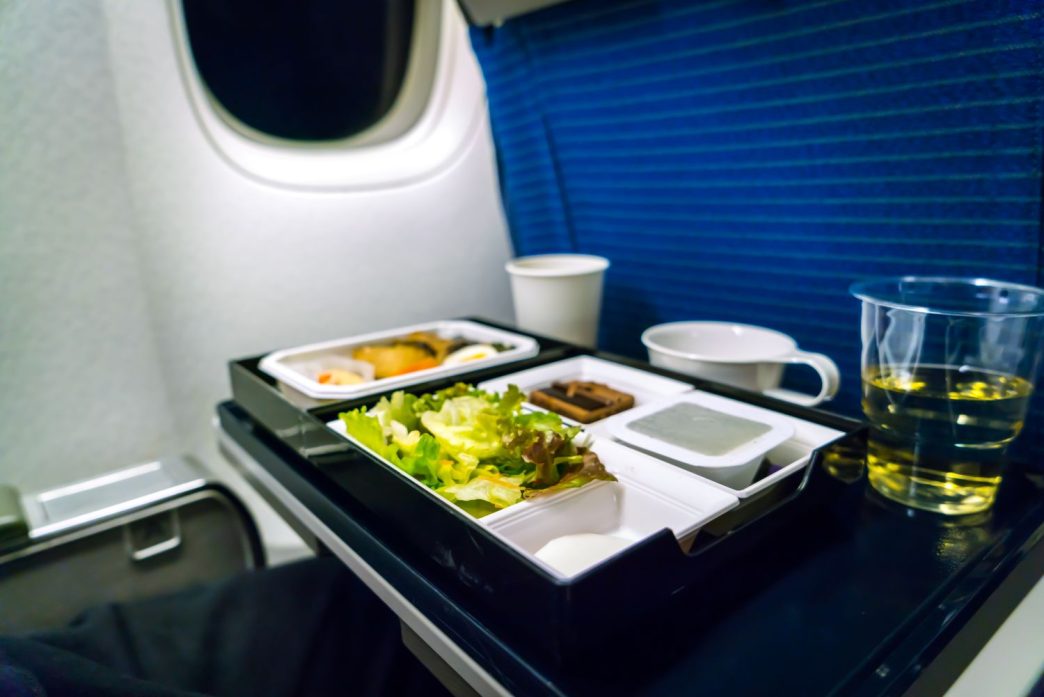
Anyone who regularly flew across the Atlantic a decade or so ago probably remembers what economy-class service used to look like: two meals during the flight, with drinks and snacks in between. Today, many airlines offer considerably less. The second meal has often been replaced by a sandwich, pastry, cookie, or a small snack.
Still, the experience varies from airline to airline. British Airways and United, for example, continue to serve two meals on certain long-haul flights. With some other carriers, however, there has been a clear reduction in the amount of food passengers receive.
Lufthansa is a good example. In late 2019, before the pandemic, the airline stopped serving a second hot meal on long-haul flights in Economy and Premium Economy, replacing it with a simpler cold meal. Today, after the main meal, passengers receive a smaller hot or cold meal depending on the length of the flight, while an additional snack is not offered on every route.
In other words, airlines were cutting back on food even before the pandemic. COVID-19 simply accelerated the trend.
COVID Changed the Rules
When the pandemic began in 2020, airlines scaled back their in-flight service even further. This time, cost-cutting was not the only reason. Airlines were also trying to limit contact between passengers and cabin crew.
The International Air Transport Association (IATA) recommended limiting onboard service to essential items and making greater use of pre-packaged food. The International Civil Aviation Organization (ICAO) issued similar recommendations, particularly regarding the serving of food and beverages.
At the time, there were legitimate public-health reasons for these measures. But they also demonstrated to airlines that flights could operate with less food and simpler service.
The pandemic is over and most restrictions have been lifted, but food service on many flights has not returned to what it was before.
When a “Second Meal” No Longer Means the Same Thing
It is not always easy to determine how many meals passengers actually receive on a long-haul flight, because the offering varies considerably between airlines.
British Airways, for example, offers economy passengers a main meal, snacks during the flight, and another meal on longer routes. United also serves a main meal and another meal before landing, while passengers on flights longer than 12 hours may receive an additional sandwich.
KLM serves a hot meal, salad, and dessert on intercontinental flights, with an additional snack or sandwich on flights longer than ten hours. Its offering used to be more generous. When KLM introduced a new Economy Class menu in 2018, passengers were offered a substantial hot meal, salad, and dessert, as well as a wider selection of ice cream, sweet treats, and savory snacks on longer flights.
That is why simply saying that an airline serves “two meals” tells us little about how much food passengers actually receive. A second meal might mean a full tray with a hot entrée, side dish, and dessert — or it might mean a sandwich or small snack shortly before landing.
What Does an Airline Meal Really Cost?
It may seem strange that a major airline would try to save money on a single meal, sandwich, or dessert. But the cost of an airline meal goes well beyond the food on the tray.
Food has to be purchased, prepared, packaged, chilled, transported to the airport, loaded onto the aircraft, and stored onboard. There are also costs associated with dishes, cutlery, carts, and beverages. Once the meal is over, leftovers and packaging have to be collected, unloaded, and disposed of.
The scale of the business is illustrated by gategroup, one of the world’s largest airline catering companies, which generated €5.61 billion in revenue in 2025 alone.
Replacing a full second meal with a smaller snack therefore saves more than just the difference in the cost of the food itself. It requires fewer ingredients and less packaging, takes up less space onboard, and produces less waste. The saving per passenger may be small, but multiplied by hundreds of passengers on each flight and thousands of flights a year, it can become significant.
What Happens to the Food Passengers Don’t Eat?
Uneaten food is another major problem for airlines. They have to load enough meals for their passengers before departure, without knowing exactly how much of that food will actually be eaten.
According to IATA, passenger cabins generated around 3.6 million tonnes of waste in 2023, an average of 0.94 kilograms per passenger. An earlier analysis of waste from flights at London Heathrow Airport found that unopened food and beverages accounted for as much as 23 percent of the waste examined.
For airlines, this creates a double expense: they first pay to purchase, prepare, and load the food, and then pay to remove and dispose of what passengers leave behind.
This is one reason why advance meal selection is becoming increasingly important. Knowing what passengers want before departure allows airlines to estimate more accurately how much food they need, reduce waste, and cut costs at the same time.
The New Economics of an Airline Ticket
Changes in food service are part of a much broader shift in the way airlines do business. Many services that were once included in the ticket price are now sold separately. Seat selection, priority boarding, and numerous other extras have become additional sources of revenue.
This business model generates enormous sums. According to an IATA forecast, airlines are expected to earn around $165 billion from ancillary and other revenues in 2026, 12.6 percent more than the previous year.
Of course, most of that money does not come from selling food. But the figure shows just how important additional services have become to the airline business. Rather than including everything in the ticket price, airlines increasingly separate individual services and charge for them. The aim is to generate as much revenue as possible from each passenger’s journey.
The Food Hasn’t Disappeared – It Has Moved to the More Expensive End of the Plane
The contrast becomes even clearer when Economy is compared with Business and First Class. While airlines look for savings even on the second meal in Economy, food in premium cabins is an important part of the service used to justify far more expensive tickets.
In 2026, for example, Air France introduced new desserts for Business Class passengers created by renowned French pastry chef Nina Métayer. Lufthansa offers First Class passengers caviar, Veuve Clicquot La Grande Dame champagne, and meals served on fine porcelain.
The reason is straightforward. In Economy, airlines try to keep food costs as low as possible. In Business and First Class, where tickets can cost several thousand dollars, high-quality food becomes one of the reasons passengers may be willing to pay more.
Premium Economy provides an interesting example of what is happening between those two ends of the cabin. British Airways specifically lists two meals among the benefits of its World Traveller Plus service. Something that was once common on long-haul Economy flights can therefore become a selling point for a more expensive ticket.
Cutting Back on Meals as Part of a New Business Strategy
Airlines have not stopped serving food on long-haul flights, but many carriers have simplified their meals and reduced the size of the second service. There is no single reason behind the change. Airlines are trying to reduce the cost of buying and preparing food, cut waste, and lower the many other expenses associated with onboard catering.
At the same time, the difference in service between Economy and premium cabins is becoming increasingly pronounced. While airlines calculate how much can be saved on each Economy meal, food in Business and First Class is used to encourage passengers to pay for a more expensive ticket.
Smaller meals are therefore not simply the result of airlines spending less on food. They are part of a broader change in the airline business: keeping the basic service as inexpensive as possible while earning more from passengers who are willing to pay for greater comfort and better service.
Photo: Magnific