

The news that Russian technology company Sber had published a sequel to Dead Souls, the novel by Nikolai Vasilyevich Gogol, created with the assistance of artificial intelligence, has reignited the debate over the boundaries between authentic literary creation and algorithmic imitation of style.
Headlines suggesting that a machine had “written the burned second volume” presented an incomplete picture of the undertaking. In fact, it was a two-year literary experiment and an extensive publishing project involving Sber’s artificial intelligence laboratory (Sber AI Lab), the advanced GigaChat MAX model, and a team of Russian writers and philologists.
The use of artificial intelligence to imitate the styles of literary classics raises questions about the extent to which readers, and even literary experts, can recognize an authentic author’s voice. It also raises the question of whether a text produced in this way can possess literary value.
How the Second Volume of Dead Souls Was Actually Created
The book Dead Souls. Volume Two. Rebirth, published by Ripol Classic, runs to 464 pages. Approximately 350 pages contain the literary text, while the remainder is devoted to a detailed account of the methodology used. The project’s leader, writer Vladislav Otroshenko, and representatives of Sber emphasize that their goal was not to reconstruct the manuscript Gogol burned in February 1852, just about ten days before his death in Moscow. Nor was the work presented as a rediscovered, lost original.
The creative team deliberately chose not to use the five surviving drafts of chapters from the second volume. Instead of completing the existing fragments, the sequel begins where the first volume ends. Otroshenko’s explanation that a moralistic transformation of Pavel Ivanovich Chichikov would undermine the character’s internal logic and credibility reflects the creative team’s interpretation, not a historically established explanation of why Gogol destroyed the manuscript.
How GigaChat MAX Was Trained and Guided
Producing the text was considerably more complex than giving a language model a simple prompt. GigaChat MAX was trained on a corpus comprising more than two million characters and over 80 author’s sheets of written material. In addition to novels and short stories, the researchers analyzed Gogol’s letters and personal notes. His correspondence with publishers helped shape the administrative and business language of the 19th century, while letters to close friends helped the model reproduce his conversational tone, wit, and characteristic sentence structures.
Human participants planned each scene in advance and supplied the model with a precise narrative framework, from Chichikov’s arrival in a new setting to local rumors and the dynamics of dialogue. The generated passages then underwent multiple rounds of revision. Editors rejected unsuccessful sections and provided specific instructions for rewriting and expanding them.
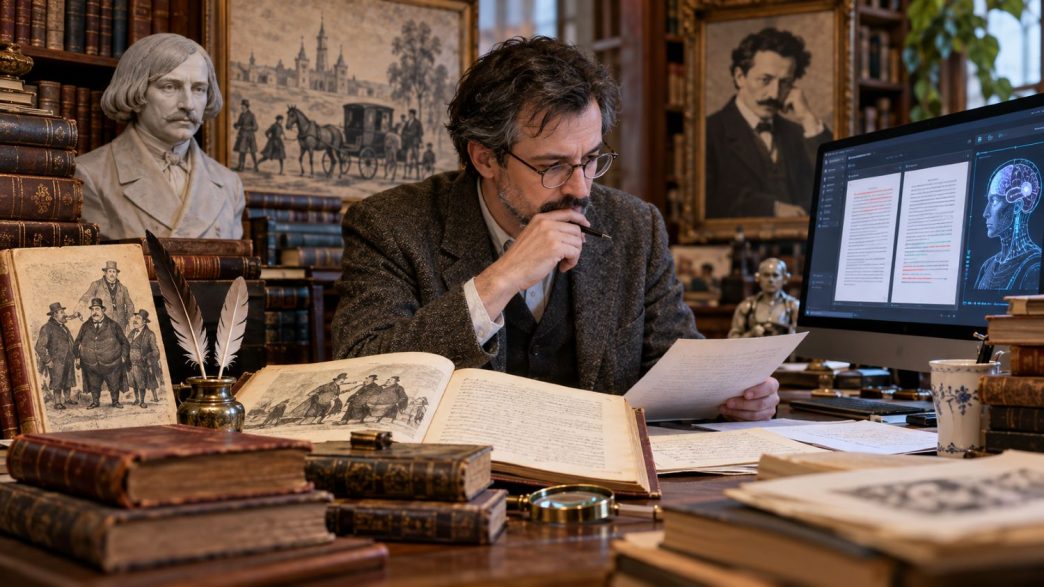
Artificial intelligence was also used to create illustrations for the printed edition. The book was released in digital format as well, along with an audiobook narrated by Russian actor Mikhail Gorevoy.
My Experience With Nušić
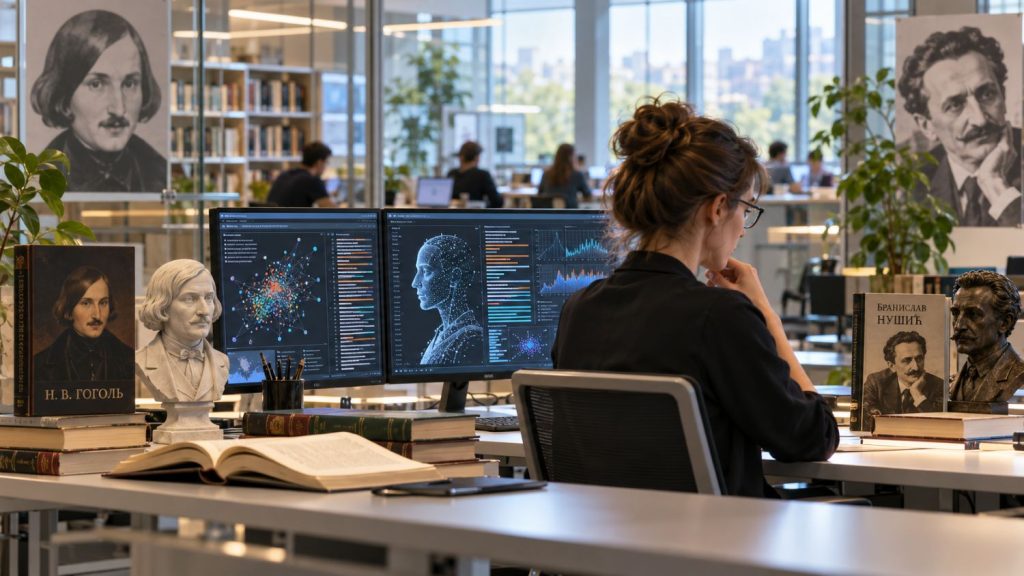
Nearly two years ago, I developed a chatbot — a digital double of our celebrated playwright Branislav Nušić — that provides information about his life and work in the first person. The aim was to create a chatbot that could write as convincingly as possible in Nušić’s style and imitate his humor.
Following an approach similar to that of the Russian researchers, I trained the chatbot on a corpus of Nušić’s comedies, plays, and short stories, with instructions to reproduce his writing style as faithfully as possible. Over time, its responses became convincing enough to raise a question: could even those who work professionally with Serbian language and literature distinguish the difference?
That is why, a year ago, I conducted a study to examine whether readers could distinguish Nušić’s original writing from texts generated by artificial intelligence. I instructed the chatbot to write four paragraphs on specific topics and then compared them with four excerpts from Nušić’s lesser-known works. I presented the selected texts to teachers and professors of Serbian language and literature, whose task was to determine which excerpts had been written by Nušić and which by artificial intelligence.
The results showed that approximately half of the respondents were unable to make this distinction. This finding indicates how convincingly artificial intelligence can imitate the style of a literary classic, even when the readers are professionals working in language and literature.
You can read more about the research in an academic paper I co-authored with Dr. Milena Škobo:
Do AI-Generated Texts Have Literary Value?
The fact that a majority of respondents confused authentic excerpts with those written by the chatbot does not demonstrate the creation of a new literary work, but rather the successful imitation of form. The model demonstrated that it could reproduce the outward characteristics of a writer’s style: sentence rhythm, archaic vocabulary, and distinctive syntactic constructions. However, that alone is not enough to turn a text into a literary work.
Literary value involves a sense of completeness, the internal logic of a plot, complex psychological development of characters, and meaning shaped by lived experience and the historical context of a particular era. While a machine can create a convincing stylistic illusion in just a few sentences, constructing a complex and coherent literary work presents a far greater challenge. The Russian project to continue Dead Souls illustrates this point. The algorithm was not entrusted with shaping the entire work independently. Instead, the human creative team devised scenes, guided the generation of the text, and intervened wherever necessary to preserve its coherence of meaning and consistency of style.
Ethical Dilemmas
Both examples raise important ethical questions. The first concerns transparency: any work or passage created after the fact must be clearly identified as a contemporary stylistic imitation so that it is not presented as an authentic work by a literary classic. The second concerns respect for the author’s wishes and creative integrity. In Gogol’s case, the question remains whether it is justifiable to continue and publish a work that the writer himself consciously chose to destroy.
Artificial intelligence in literature thus appears to be developing more as a sophisticated tool for language modeling and interpretation than as a creator of original literary value. Its contribution to culture should not be measured by whether it can replace Gogol or Nušić, but by how much it can, with appropriate human guidance, deepen our understanding of their language and bring their work closer to readers in the digital age.