

The way student protests in Serbia are organized resembles several American protest movements: they have no publicly identified leaders, decisions are made at collective gatherings—assemblies and plenums—university buildings and public spaces are occupied, and social media serves as the main channel for organizing activities and informing the public. In the United States, blockades have often ended with police intervention. The resulting costs have run into millions of dollars—and, during the unrest of 2020, exceeded $1 billion.
The months-long blockades of universities, roads, and public institutions in Serbia have raised a question that has largely remained in the background: How much does this form of protest cost the government, universities, businesses, and the public?
No reliable, comprehensive figure has been published for the financial damage caused by the student protests in Serbia. Various estimates have appeared in public, but there has been no precise accounting that distinguishes between losses directly caused by the blockades and those attributable to other economic circumstances. It is therefore not yet possible to state responsibly exactly how much the blockades have cost the country. 
The experience of the United States, however, shows the kinds of costs that can arise when blockades continue for weeks or months. It also shows how American authorities responded when they concluded that the normal operations of universities and other institutions were being prevented.
Protests Without Officially Identified Leaders
The most apparent similarity between the protests in Serbia and American protest movements lies in the way they are organized.
Students in Serbia officially have no publicly identified leader or single body authorized to make decisions on behalf of the entire movement. Decisions are made at plenums, while individual universities and local groups retain a degree of independence. A similar model was used by Occupy Wall Street, which began in New York City in 2011. Its participants made decisions at collective gatherings and refused to appoint official representatives.
Later American movements were also organized without a unified leadership. Black Lives Matter did not have a single center directing all its local groups. The pro-Palestinian student protests of 2024 spread from one university to another, likewise without a common nationwide leadership.
The similarities also include blockading universities and roads, as well as a clear division of responsibilities—from public communications and maintaining order to obtaining food, arranging transportation, and providing legal assistance. Another shared feature is an effort to maintain a formal distance from political parties.
Social media plays an important role in publishing decisions, mobilizing participants, and circulating footage of confrontations. At the same time, the movements establish their own communication channels to reduce their dependence on traditional media.
How the Blockades Ended in the United States
The American protests did not end through a negotiated settlement, nor were all the demonstrators’ demands met.
Occupy Wall Street encampments were removed after several weeks or months. In New York, police cleared Zuccotti Park, removed the tents, and arrested demonstrators who refused to leave. Authorities in other cities took similar action.
During the protests following the killing of George Floyd in 2020, local authorities imposed curfews, deployed additional police officers, and arrested those who failed to comply with orders to disperse. The protests gradually lost momentum.
U.S. university administrations took two different approaches during the 2024 protests. Some negotiated with students and agreed to meet some of their demands or reduce the disciplinary penalties imposed on participants.
Where negotiations failed, university administrations called the police. Officers removed tents, cleared occupied buildings, and arrested protesters who refused to leave campus.
Police removal of blockades was therefore not exceptional in the United States. Students faced suspensions and bans from university grounds, while those who disobeyed police orders were detained or arrested. This did not necessarily end the protest itself, but it did bring the physical occupation of a university or another public space to an end.
How Much Did the Protests Cost the United States?
The financial consequences varied considerably. The costs of peaceful blockades must be distinguished from damage caused by arson, looting, and violent confrontations.
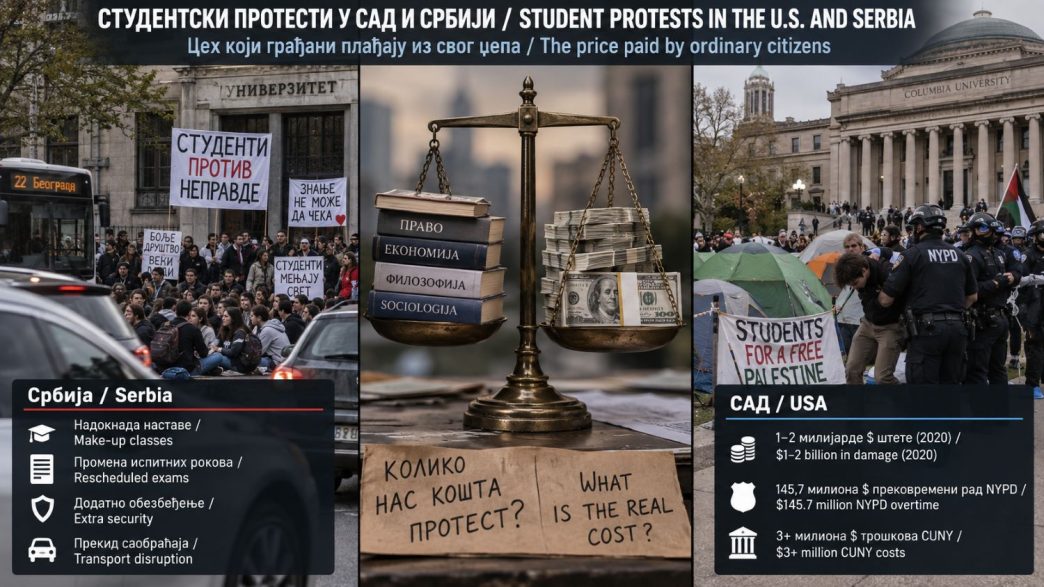
The unrest accompanying the protests after George Floyd’s killing in 2020 resulted in an estimated $1 billion to $2 billion in insured property losses. The figure included losses from looted stores, burned buildings, and other destroyed property across several U.S. states.
Taxpayers also bore a substantial share of the cost. According to the New York City Comptroller, the New York Police Department spent approximately $145.7 million on overtime during protests against police violence in fiscal year 2020.
The costs associated with student encampments were lower but still substantial. According to the City University of New York (CUNY), protests at the City College of New York resulted in more than $3 million in repair and additional security costs.
Columbia University canceled its main commencement ceremony because of security concerns. More than 50,000 students, family members, and guests had been expected to attend. The university did not disclose the total cost of hiring additional security, erecting barriers, carrying out repairs, and relocating or canceling classes and ceremonies.
How Much Have the Blockades Cost Serbia?
The blockades in Serbia have also resulted in substantial losses and additional expenses. These range from organizing make-up classes, rescheduling examinations, and hiring additional security and police officers to changing public transportation services and disrupting the operations of certain institutions. Businesses whose regular operations were hindered by the blockades have also felt the effects.
The final figures are unknown. Calculating them would require data from universities, municipal authorities, the police, public transportation operators, insurance companies, and businesses. Direct property damage would also have to be separated from security expenses and indirect losses arising from canceled classes and suspended transportation services.
The experience of the United States shows that prolonged blockades create costs even in the absence of violence or property destruction. American authorities distinguished between the right to protest and the months-long obstruction of universities, streets, and public institutions, while also protecting the rights of other citizens to move freely, attend classes, and carry out their daily activities.
When months of negotiations failed to produce results, American authorities began enforcing the law consistently: the blockades were removed, and those who refused to disperse were arrested.
Photo: ChatGPT