


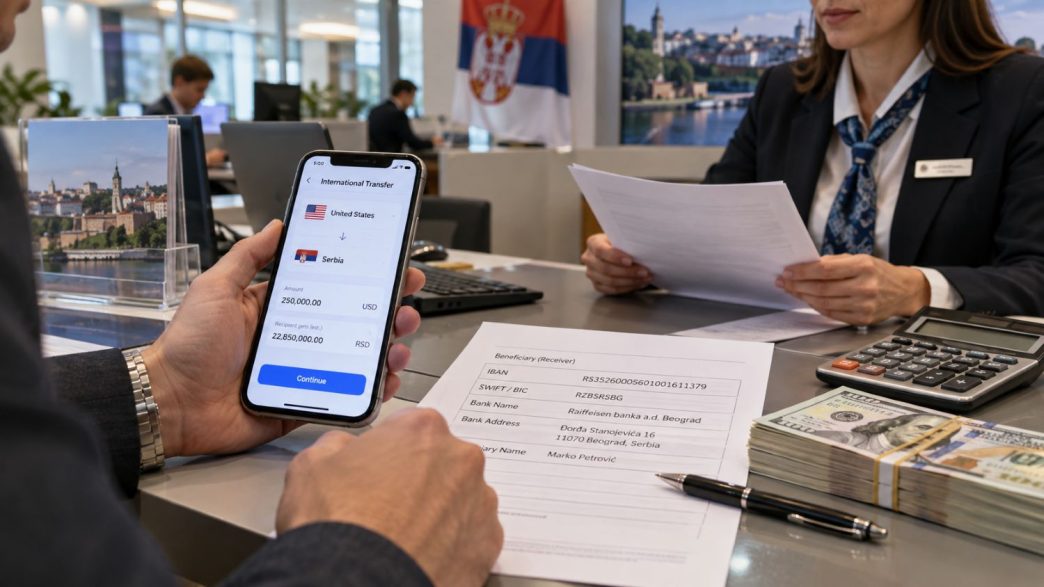
Are you transferring $5,000, $50,000, or $100,000 from a U.S. bank account to an account in Serbia? The $10,000 threshold that applies when physically carrying cash across the U.S. border does not apply to bank transfers. However, a large transfer may trigger additional bank reviews, and the recipient in Serbia may be required to explain the purpose of the payment and, in some cases, provide supporting documentation.
Here’s how to transfer money from a U.S. bank account to a Serbian account, what information you will need for an international transfer, who pays the banking fees, and what you should check before sending a large amount.
There Is No $10,000 Limit on Bank Transfers
You can transfer $20,000, $50,000, or $100,000 by bank. There is no rule that makes an international bank transfer illegal simply because it exceeds $10,000.
That does not mean, however, that every U.S. bank will allow you to send a large amount in a single transaction through online or mobile banking. Banks may impose their own daily or other transaction limits, and larger transfers may require you to contact the bank or visit a branch in person.
How Do You Transfer Money From a U.S. Bank Account to an Account in Serbia?
The most common method is an international bank transfer, or international wire transfer. Banks exchange payment information through the SWIFT network, while the funds may move directly between the two banks or through one or more correspondent banks.
Before sending the money, the recipient in Serbia should ask their bank for incoming international payment instructions. Do not simply copy the account number from a bank card or assume that the information used for domestic payments will be sufficient for an international transfer.
These instructions typically include the recipient’s name and address, account number or IBAN, the Serbian bank’s SWIFT/BIC code and, when necessary, details of a correspondent bank.
You then provide this information to your U.S. bank when initiating the international wire transfer.
You Can Also Transfer Money Between Your Own Accounts
If you live in the United States and have a foreign-currency account in Serbia, you can transfer money directly from your U.S. account to your own account in Serbia.
Suppose you have worked in the United States for years and accumulated $80,000 in savings, which you now want to transfer to Serbia. The fact that the amount is $80,000 does not, by itself, prevent you from making the bank transfer.
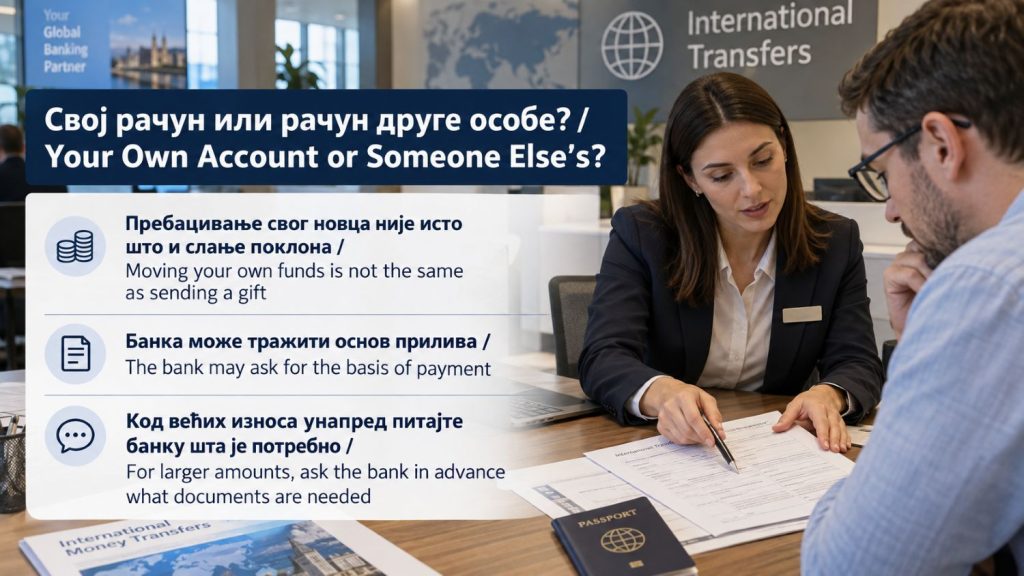
Likewise, moving your own money from one of your accounts to another does not, by itself, constitute income. The money does not become income simply because it moved from your U.S. bank account to your account in Serbia. Any tax liability depends on how the money was originally acquired and on the account holder’s tax status, rather than on the transfer between the two accounts itself.
If you are a U.S. citizen or resident and have an account in Serbia, you may also be required to file an FBAR if the aggregate value of all your foreign financial accounts exceeds $10,000 at any time during the calendar year; this is a separate reporting requirement, not a tax on the transfer itself.
What Happens When the Money Arrives in Serbia?
When funds from abroad reach a Serbian bank, the bank must determine the basis for the incoming payment and comply with Serbia’s foreign-exchange and anti-money-laundering regulations.
That does not mean every large transfer will automatically be held. However, for a large or unusual incoming payment, the bank may request additional information or documentation before completing the transaction.
What Can the Bank Ask for as Proof of the Source of Funds?
That depends on where the money came from.
If you are transferring your own savings, bank statements from your U.S. account and other documents showing how the funds were earned and accumulated may be relevant. If the money came from the sale of a house or other property, the bank may request the sale agreement and evidence that the proceeds were deposited into your U.S. account. Different documentation may be required for an inheritance, gift, or another source of funds.
In other words, “proof of source of funds” is not a single document that you obtain for every transfer. The documentation depends on the actual source of the money.
For that reason, if you are planning to transfer, for example, $50,000 or $100,000, it is advisable to contact the bank in Serbia beforehand and explain how much money you expect to receive, where it is coming from, and the reason for the transfer. The bank can then tell you what documentation, if any, it will require.
Pay Close Attention to the Currency You Are Sending
If you hold U.S. dollars in America and have a U.S. dollar-denominated foreign-currency account in Serbia, you can send the dollars directly to that account. This can be important because it may avoid an unnecessary currency conversion during the transfer.
If the money is converted from dollars into euros or Serbian dinars somewhere along the way, the exchange rate used for that conversion can significantly affect how much money you ultimately receive.
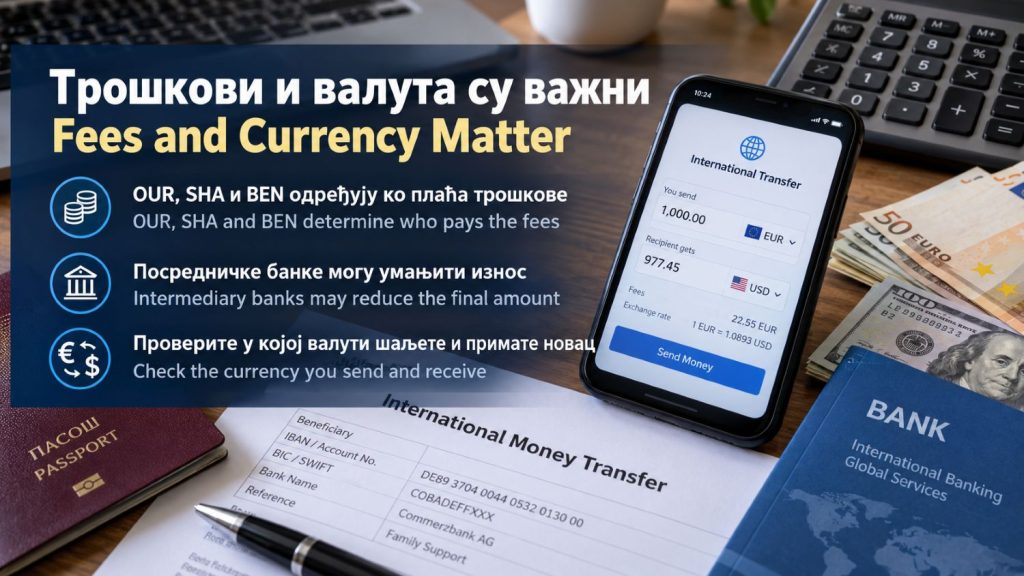
With a small transfer, the difference may not be substantial. With $50,000 or $100,000, even a relatively small difference in the exchange rate can amount to hundreds or thousands of dollars.
Before sending the money, therefore, check not only how much the U.S. bank charges for the transfer, but also which currency will be sent and which currency will ultimately be credited to the account in Serbia.
Who Charges the Fees, and Why Might Less Money Arrive in Serbia Than You Sent?
When you send money from a U.S. bank to an account in Serbia, your U.S. bank may not be the only bank charging a fee. International transfers do not always move directly from the U.S. bank to the Serbian bank. They may pass through one or more intermediary, or correspondent, banks, each of which may charge its own fee.
For example, if you send $10,000 from the United States, that does not necessarily mean exactly $10,000 will be credited to the account in Serbia. Your U.S. bank may charge an outgoing wire fee, an intermediary bank may deduct its own fee, and the Serbian bank may also charge a fee for receiving an international payment. How much of these costs is paid by the sender and how much by the recipient also depends on the fee arrangement selected for the transfer.
This is where the terms OUR, SHA, and BEN come in. With OUR, the sender covers the transfer charges, with the intention that the recipient receives the full amount sent. With SHA, the charges are shared: the sender pays the fees charged by their own bank, while the recipient bears the remaining banking charges. With BEN, all transfer charges are borne by the recipient and deducted from the amount being transferred.
So before sending a large amount, do not ask your U.S. bank only, “How much do you charge for an international wire?” Also ask whether intermediary banks are likely to be involved, who will bear those charges, and how much is expected to be credited to the recipient’s account in Serbia.
Sending Money to Someone Else Is Different From Transferring Money to Yourself
Transferring $50,000 from your U.S. account to your own account in Serbia is not the same as sending $50,000 to another person.
If you are sending money to a parent, child, relative, or anyone else, the Serbian bank needs to know the basis on which the recipient is receiving the funds. The documentation and potential tax consequences may differ depending on whether the money is a gift, a loan, payment for something, or is being transferred for another reason.
For large transfers, you should therefore avoid entering a vague or inaccurate payment description simply to get the transfer processed. The stated purpose of the payment should reflect the actual reason the recipient is receiving the money.