


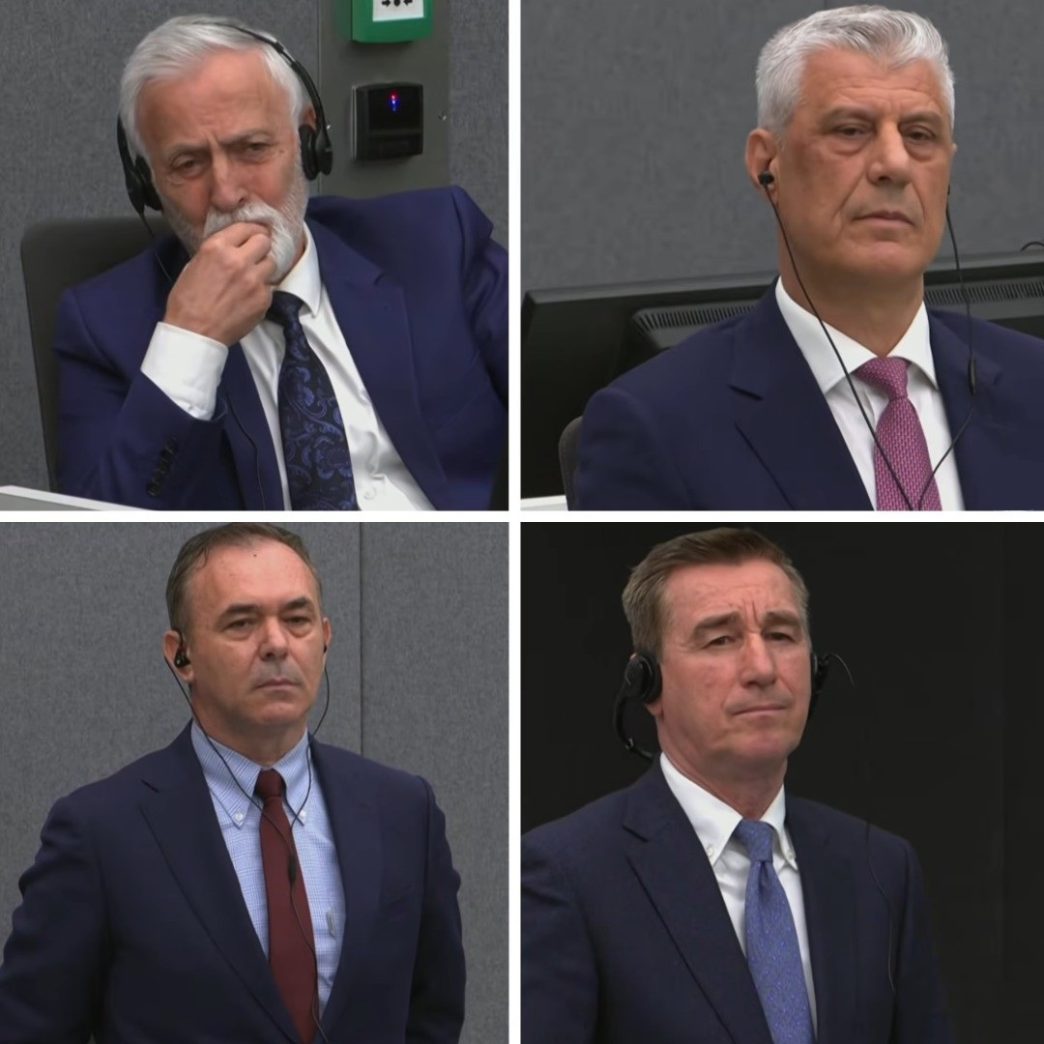
Hashim Thaçi, Jakup Krasniqi, Kadri Veseli, and Rexhep Selimi have been convicted of war crimes involving the unlawful detention of hundreds of people, torture, cruel treatment, and the murder of 96 individuals. Yet none of the four will spend the rest of his life in prison. The judgment has once again raised questions about the standards by which Serbian commanders received life sentences, while KLA crimes remained largely overlooked for years.
Four former leaders of the so-called Kosovo Liberation Army have been sentenced by the Kosovo Specialist Chambers in The Hague to a combined 81 years in prison.
Hashim Thaçi, the former president of the fake state of Kosovo, was sentenced to 25 years, as was Jakup Krasniqi. Kadri Veseli received 18 years, while Rexhep Selimi was sentenced to 13. The time they have spent in detention since 2020 will be credited toward their sentences. The judgment is a first-instance ruling, and both the defense and the prosecution may appeal. 
The court found the four former KLA leaders responsible for war crimes committed against civilians and political opponents. According to the judgment, 385 people were unlawfully detained, 303 detainees were tortured, 49 people were subjected to cruel treatment, and 96 were murdered.
The victims were not only Serbs and Roma, but also Albanians whom the KLA had branded “collaborators with Serbia,” “traitors,” or political opponents. Presiding Judge Charles Smith emphasized that there was no evidence that the victims had actually been spies or collaborators with the Serbian authorities. In some cases, having Serbian friends or working for a Serbian company was enough for someone to be labeled an enemy.
The Crimes Were Proven, Yet There Were “No Crimes Against Humanity”
The Trial Panel acquitted the defendants on six counts relating to crimes against humanity, finding that the prosecution had failed to prove that the crimes formed part of a widespread or systematic attack directed against a civilian population.
That reasoning inevitably raises the question of what more needed to be proven.
The existence of more than 40 KLA detention facilities in Kosovo and Metohija and Albania was established. So were the unlawful detention and torture of hundreds of people, cruel treatment, and 96 murders. It was also established that victims had been selected on ethnic grounds. Nevertheless, in the Trial Panel’s assessment, the prosecution failed to prove the widespread or systematic attack required for a conviction for crimes against humanity.
The four KLA leaders were not even charged with genocide. By comparison, General Ratko Mladić was sentenced to life imprisonment in 2017 for the “genocide” in Srebrenica.
It is therefore legitimate to ask whether international justice applied the same standards to all parties involved in the wars in the former Yugoslavia.
Why No Life Sentences for 96 Murders?
The prosecution sought a sentence of 45 years for each of the four defendants. The court imposed substantially shorter sentences, ranging from 13 to 25 years.
When these sentences are compared with the life sentences imposed on Serbian commanders, it is difficult to escape the impression that a Serbian victim’s life did not carry the same weight in the courtrooms of The Hague.
For decades, Serbs were told that it was not “all Serbs” who were on trial, but individuals. In practice, however, judgments against Serbian officers and leaders were often used to condemn and persecute an entire people. The question now is whether the collective West will also assign collective guilt to the Albanian people for the crimes of their military and political leaders.
Stones, Water Cannons, and an Attack on EULEX
Protesters clashed with Dutch police outside the Kosovo Specialist Chambers in The Hague. Some climbed onto police vehicles, while officers were pelted with stones, branches, bottles, and other objects. Police deployed pepper spray and a water cannon, and several people were detained. According to Dutch media reports, at least one police officer was injured.
Unrest was also reported in Priština. Masked protesters threw stones at the compound of the European Union Rule of Law Mission, EULEX, smashing several windows.
It should be recalled that Ratko Mladić’s conviction was followed by gatherings, political reactions, and public outrage, but his supporters did not launch an uncivilized and savage attack on the courthouse in The Hague, police vehicles, or international missions. Serbs may have regarded the judgment as unjust and politically motivated, but their disagreement with the court did not turn into violence on the streets of The Hague.
This contrast is all the more striking because Serbs have for decades been portrayed as the sole culprits for the wars and instability in the Balkans.
(In)Justice That Arrived Too Late
The judgment against the four KLA leaders is important because an international court has finally established that the KLA did not merely wage a “war of liberation,” as it was portrayed in the West for years. Its structures unlawfully detained, tortured, and murdered civilians and political opponents, and these crimes were not isolated acts committed by individuals.
Yet this judgment cannot erase the fact that justice for Serbian victims arrived almost three decades late, that many crimes were never prosecuted, and that former KLA commanders meanwhile became presidents, prime ministers, and parliamentary speakers with the political backing of Western governments.
For years, the West welcomed Hashim Thaçi as a statesman and ally. A special court was established only after earlier proceedings were accompanied by allegations of witnesses disappearing, being intimidated, or changing their testimony. It was precisely because of the danger of pressure being exerted on witnesses that the court was relocated to The Hague.
This judgment therefore represents a measure of justice, but it does not prove that double standards have disappeared. On the contrary, comparison with the sentences imposed on Serbian officials demonstrates how much indictments, legal classifications, and sentencing policies depended on who was sitting in the dock.
Sources: scp-ks.org/sr, irmct.org/en, AP, NL Times Photo: Printscreen