


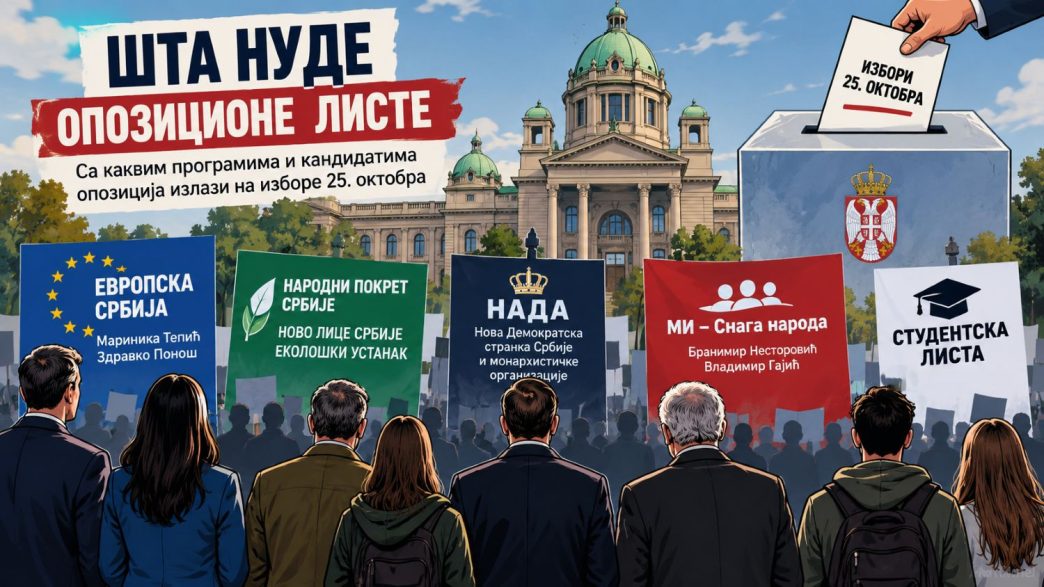
Opposition parties will contest the October 25 snap parliamentary election on several separate lists, while some have chosen to support the student list. Most parties have adopted platforms and have officials with political or professional experience. However, the newly formed coalitions have yet to publish joint election platforms, complete candidate lists or the names of those they would nominate for senior posts in a future government.
European Serbia
The Party of Freedom and Justice, led by Dragan Đilas; Serbia Centre, led by Zdravko Ponoš; and Goran Ješić’s Solidarity Civic Movement will contest the election on a joint list entitled “European Serbia – Marinika Tepić – Zdravko Ponoš.”
The alliance supports Serbia’s accession to the European Union, stronger public institutions, measures to combat corruption, and changes to economic and social policy. The Party of Freedom and Justice has previously presented the policy documents Serbia 2030 and Plan for a Stronger Economy, while Serbia Centre has a platform entitled Serbia’s Recovery and committees dealing with healthcare, education, agriculture, foreign policy and other areas. 
Marinika Tepić and Zdravko Ponoš have been presented as the leading figures on the list. Other prominent members of the alliance include Dragan Đilas, Dušan Nikezić, Duško Lopandić, Dragan Delić and Goran Ješić. When the list was unveiled, the alliance also announced measures for the first 100 days of a new government. A comprehensive platform setting out detailed measures and funding arrangements has yet to be made public. The coalition has also not announced whom it would nominate to lead individual ministries.
People’s Movement of Serbia, New Face of Serbia and Ecological Uprising
The People’s Movement of Serbia, led by Miroslav Aleksić; New Face of Serbia, led by Miloš Parandilović; and Aleksandar Jovanović Ćuta’s Ecological Uprising have announced a separate list.
In their public statements, these organizations have emphasized the fight against corruption, changes to electoral conditions, stronger local government and a different approach to managing the country’s natural resources. The People’s Movement of Serbia places particular emphasis on agriculture and more balanced regional development. Ecological Uprising opposes certain mining projects that it believes could harm the environment.
The alliance’s most recognizable figures are the leaders of its three constituent organizations: Aleksić, Parandilović and Jovanović. All three have parliamentary experience, but the coalition has yet to present a joint election platform or a broader team that would take responsibility for the economy, public finances, healthcare, education and foreign policy.
The NADA Coalition
The NADA coalition, formed around Miloš Jovanović’s New Democratic Party of Serbia and several monarchist organizations, describes itself as a national and conservative opposition alliance.
Its platform is based on keeping Kosovo and Metohija within Serbia, maintaining military neutrality, protecting national interests and changing Serbia’s current policy toward the European Union. The monarchist wing of the alliance also supports the restoration of a parliamentary monarchy.
The coalition’s leading figure is New DSS president Miloš Jovanović. MP Predrag Marsenić is another of its better-known representatives. NADA has clearly defined positions on state and national issues, but it has yet to present a complete platform for the forthcoming election or identify the people who would be responsible for economic and social policy and the management of public services.
We – Power of the People and the People’s Party
Branimir Nestorović’s We – Power of the People movement and Vladimir Gajić’s People’s Party have agreed to contest the election together.
The People’s Party has a formally adopted platform and has also presented a document entitled The Serbian Question in the 21st Century. It calls for changes to the electoral system, stronger national sovereignty, the preservation of Kosovo and Metohija, opposition to lithium mining and a reassessment of Serbia’s relationship with the European Union.
We – Power of the People holds similar national and sovereignty-focused positions and opposes Serbian membership in NATO. The alliance’s most prominent figures are physician Branimir Nestorović and lawyer Vladimir Gajić. Lawyer Branko Lukić and physician Borislav Antonijević also frequently speak on behalf of the We movement.
The alliance has yet to publish a joint election platform, a complete candidate list or an outline of how responsibilities for the main areas of government policy would be divided.
The Student List
Students participating in the blockades have formed a citizens’ group called “Student List – Students Will Win.” Its independent election campaign has been endorsed by the Democratic Party, the Green–Left Front, the Movement of Free Citizens and the Go-Change movement. According to their announcements so far, these organizations will not field separate lists.
The Student List has yet to present a comprehensive platform covering the economy, taxation, healthcare, education, agriculture, energy and foreign policy. The names of 14 founders of the citizens’ group have been released. They include Marija Maruna, Katarina Šćepanović, Goran Perišić, Stanislav Milošević, Aleksandar Čupić, Miljan Salata, Milica Jovanović and Željko Hubač.
They have not been presented as candidates to head government ministries. The complete list of 250 parliamentary candidates has also yet to be published, leaving the public without sufficient information to assess their education, experience and ability to perform parliamentary or government duties.
A Party Platform Is Not the Same as a Plan for Governing
The opposition parties have their own platforms, political objectives and proposals in individual policy areas. However, none of the coalitions discussed here has yet published a joint platform setting out specific measures, implementation deadlines and sources of funding. Nor has the public been told who might be chosen to oversee key areas such as public finances, the economy, healthcare, education, internal affairs and foreign policy.
There are even more unanswered questions surrounding the Student List, as neither its complete platform nor most of its candidates have been made public.
Only after the full platforms and the names of candidates have been published will voters be able to make an informed assessment of all those contesting the election.
Foro: ChatGPT