

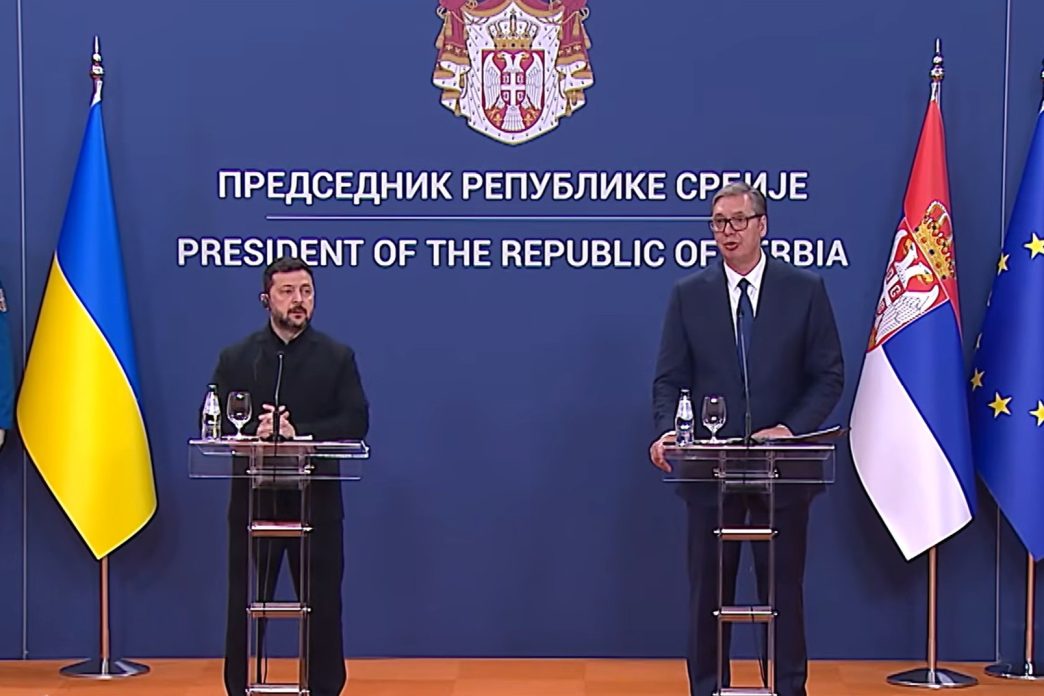
The first official visit by Ukrainian President Volodymyr Zelenskyy to Serbia was enough for virtually every side to see in it confirmation of its own interpretation of Serbian foreign policy.
Some Western media outlets have portrayed Zelenskyy’s arrival in Belgrade as a sign of the gradual weakening of Russian influence over Serbia, Ukrainian sources have described it as a diplomatic breakthrough in a country traditionally close to Moscow, while Russian media have warned of Western pressure and attempts to distance Belgrade from Russia.
Within Serbia itself, reactions have ranged from claims that the visit represents a dangerous geopolitical shift to assessments that it demonstrates precisely the opposite — that Belgrade does not have to choose between Moscow and Kyiv.
However, if Serbia’s concrete actions are considered instead of the competing interpretations, it is difficult to find evidence in the visit of any radical change in course. Serbia has not imposed sanctions on Russia and has not severed its political or economic ties with Moscow.
At the same time, since the beginning of the war, it has recognized Ukraine’s territorial integrity, provided humanitarian assistance, and developed relations with Kyiv. Ukraine, for its part, has not recognized Kosovo’s independence, and Zelenskyy reiterated in Belgrade that this position had not changed.
Western Media See a Signal to Moscow
Serbia’s geopolitical position was one of the central themes in Western media coverage of the visit.
Reuters placed the visit in the context of Serbia’s traditional ties with Russia and its simultaneous ambition to become a member of the European Union. The agency noted that Belgrade has not imposed sanctions on Moscow, while also supporting Ukraine’s territorial integrity and providing assistance to the country. According to Reuters, the visit could further strain Serbia’s relations with its traditional ally, Russia.
The Associated Press went a step further. It described Serbia as a country performing a “delicate diplomatic balancing act” between its historic ties with Moscow and its aspirations for EU membership. AP also cited analysts who argued that, by coming to Belgrade, Zelenskyy could demonstrate the weakening of Russian influence in the Balkans, while Vučić could use the visit to strengthen relations with the West. This, however, represents an analytical interpretation of the two presidents’ motives rather than a concrete outcome of their talks in Belgrade.
European Media Highlight Serbia’s Balancing Act
Euronews was even more direct, stating in its headline that, by giving Zelenskyy a ceremonial welcome, Vučić had sent a signal to both Brussels and Moscow. For a European audience, the image itself was particularly striking: the Ukrainian president being received with the highest state honors in a country that has not imposed sanctions on Russia and continues to maintain close relations with Moscow.
France’s Le Monde highlighted the same contrast, presenting Zelenskyy’s arrival as a significant visit to Serbia, which it described as a Russian ally and one of the few European countries to have maintained close relations with Moscow.
Yet the very facts cited by Western media also reveal the limitations of the argument that Serbia is undergoing a geopolitical realignment. Only a few weeks earlier, at a summit in Kyiv, Serbia had pledged additional humanitarian assistance to Ukraine but declined to support a regional declaration calling for continued security assistance to Kyiv and additional pressure on Russia.
In other words, cooperation with Ukraine has not simultaneously translated into Serbia’s acceptance of a policy of pressure on Moscow.
Ukraine Has Interests of Its Own
For Ukrainian media, the very fact that Zelenskyy traveled to Serbia carries considerable symbolic weight. It was his first visit to Belgrade, while Serbia is regularly described in Ukrainian analyses as one of the European countries maintaining the closest relations with Russia.
But there are concrete interests behind the symbolism as well.
In an extensive analysis of the visit, European Pravda used the provocative headline “Shells in Exchange for the EU,” raising questions about the defense industry, European integration, and what the two sides can offer one another. The Ukrainian analysis does not treat the visit as a mere courtesy meeting, but as a relationship in which both Kyiv and Belgrade have concrete political and economic interests.
One of the most tangible outcomes of the talks could be economic cooperation. Zelenskyy expressed his desire for the conditions necessary to conclude a free trade agreement between Serbia and Ukraine to be prepared by the end of the year, while the talks also covered infrastructure, energy, and other forms of cooperation.
For Serbia, however, another aspect of Ukraine’s position is particularly important: Kyiv has not recognized Kosovo. Zelenskyy confirmed in Belgrade that this position had not changed. This is precisely why relations between Serbia and Ukraine cannot simply be reduced to the question of Belgrade’s relationship with Moscow.
Russia Views the Visit More Cautiously
Some Russian media coverage viewed Zelenskyy’s arrival in Belgrade primarily through the prism of Serbia’s relations with Russia and possible Western efforts to gradually distance Belgrade from Moscow.
Considerable attention was given to critics of the visit in Serbia, including claims that it was the result of pressure from Brussels, that it was intended to demonstrate Serbia’s shift toward a Western course, and that it could damage Serbian-Russian relations.
However, Russian media also reported Vučić’s response to such criticism following the meeting. The Serbian president rejected claims that the country had lost anything by hosting Zelenskyy and said that Serbia itself decides whom it will talk to. It was also emphasized that the meeting did not include discussions on current military cooperation between Serbia and Ukraine.
Russian media coverage therefore does not provide sufficient grounds for the simple conclusion that, by hosting Zelenskyy, Belgrade has joined an anti-Russian camp. On the contrary, the debate that followed demonstrates how closely every Serbian move toward Kyiv is being watched, while Belgrade continues to insist that developing relations with Ukraine does not mean severing or worsening relations with Russia.
And What About Weapons?
The most sensitive part of the story remains Serbia’s defense industry.
Western and Ukrainian media have for some time reported on Serbian ammunition reaching Ukraine through intermediaries. Following the visit, questions were also raised about possible future cooperation in drone production and other areas of the defense industry.
Had Serbia and Ukraine announced a direct agreement on military cooperation, weapons production, or systematic direct deliveries to Kyiv following the visit, that would have significantly altered the visit’s political significance. No such agreement, however, was announced during the visit.
It is therefore necessary to distinguish between what was actually agreed and what is being discussed as a possible future development. Economic cooperation, infrastructure, energy, European integration, and preparations for a free trade agreement were concrete subjects of the talks. A new military alliance between Belgrade and Kyiv was not.
“Only the Serbian Chair”
Serbia has not changed sides because, according to the government’s position, it has never accepted the premise that it must belong to one side or the other.
Following the visit, Aleksandar Vučić summarized this policy by saying that Serbia has “only the Serbian chair.” His message was that Serbia would not seek anyone’s permission when deciding whom it would talk to.
In that context, the visit was presented as further confirmation that Serbia can develop relations with Ukraine without undermining its cooperation with Russia or abandoning its policy of maintaining good relations with different centers of power.
Particular emphasis was placed on Zelenskyy’s confirmation in Belgrade that Ukraine had not changed its position on Kosovo, as well as on Vučić’s expression of gratitude to Kyiv for respecting Serbia’s territorial integrity. A
t the same time, the visit was interpreted as confirmation of continuity in Serbian foreign policy — cooperation with Ukraine, Russia, China, the United States, France, the United Arab Emirates, and other partners, without requiring good relations with one side to be built at the expense of relations with another.
Cooperation With Kyiv Does Not Mean Confrontation With Moscow
Following Zelenskyy’s visit, Serbia did not impose sanctions on Russia. It did not sever economic or political cooperation with Moscow. It did not join calls for additional pressure on Russia. Nor did it announce a direct military alliance with Ukraine.
At the same time, Serbia is discussing economic cooperation, energy, infrastructure, and European integration with Kyiv, providing humanitarian assistance, and seeking opportunities for Serbian companies to one day participate in Ukraine’s reconstruction. Kyiv continues to respect Serbia’s territorial integrity.
This may not be a policy that fits neatly into a world divided into two opposing camps, but that is precisely its essence.
It is therefore premature to conclude that Serbia has turned against Russia. It would be equally mistaken to argue that, because of its traditionally good relations with Moscow, Serbia has no interest in developing relations with Ukraine.
On the contrary, Belgrade is seeking to preserve what it has for years presented as a foundation of its foreign policy: cooperation with different centers of power without being required to pay for a good relationship with one partner by severing relations with another.
In that sense, perhaps the most important message of Zelenskyy’s visit is not that Serbia has chosen a new side, but that it refuses to accept that others should determine which side it must choose.
If Belgrade can receive the Ukrainian president with the highest state honors, discuss trade and Ukraine’s reconstruction with Kyiv, while simultaneously refraining from imposing sanctions on Russia and maintaining relations with Moscow, then, for now, the Ukrainian president’s visit says more about Serbia’s attempt to preserve the independence of its foreign policy than about abandoning it.
Photo: Printscreen