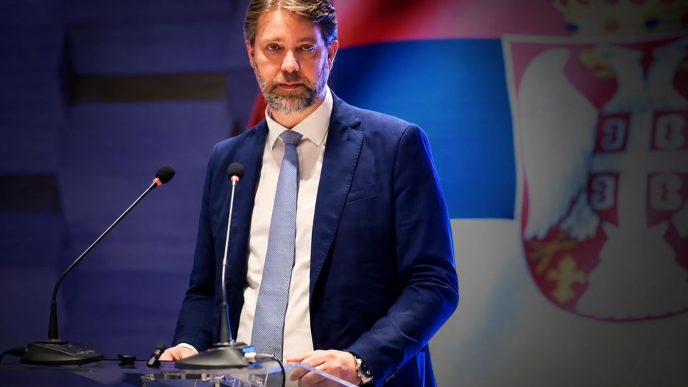



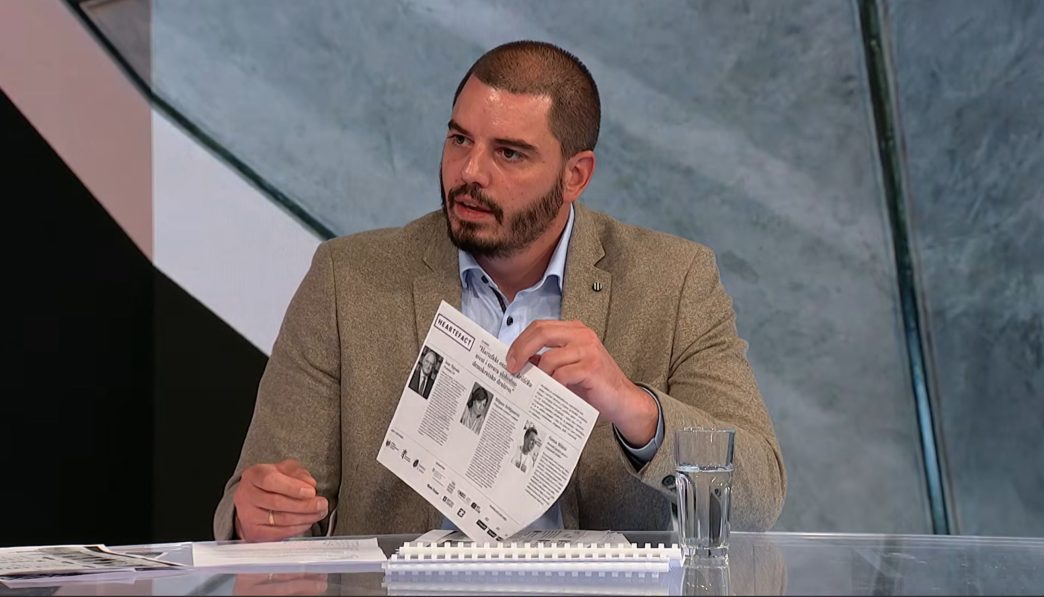
How much foreign money flows into Serbia’s nongovernmental sector, who receives it, and how much do citizens really know about who funds organizations that, in addition to social and humanitarian work, also participate in the country’s political life? These are questions that Vukša Dragović, founder of Srpski suverenisti (“Serbian Sovereigntists”), has increasingly raised in recent months as he and his associates investigate financial flows and connections among nongovernmental organizations, media outlets, political actors, and foreign donors.
Particular attention has been drawn to data that Srpski suverenisti received from the National Bank of Serbia, according to which associations and foundations registered in Serbia received a total of approximately €1.3 billion from abroad between 2021 and 2025. However, the NBS response did not reveal who received that money or which countries it came from.
Dragović argues that part of Serbia’s NGO sector can no longer be viewed exclusively as civil society, but rather as a network with significant political influence, which he calls the “NGO Hydra.” His assessments are forceful and politically contentious, but the transparency of funding for organizations that participate in public and political life remains a legitimate issue.
In Part One of his interview with Chicago na dlanu, Dragović discusses how he became involved in the issue, what he says he has uncovered while examining foreign NGO funding, what the National Bank of Serbia data shows, and how, in his view, the network he calls the “NGO Hydra” operates.
1. For our readers in America who are hearing about you for the first time — who are you, how did you become involved in this issue, and why did you conclude that funding of the NGO sector is one of the most important questions for Serbia’s future? What led you to establish Srpski suverenisti?
For the past decade, I have closely followed Serbian and global politics, both out of personal interest and as an active participant in numerous protests against actions taken by the current government. I became involved in the issue of how the NGO sector operates and is funded precisely through my opposition activities, where I was able to witness firsthand their presence and influence on the work of opposition parties and movements (citizens’ associations).
At the time, still young and inexperienced, I did not understand why parliamentary parties reacted with such pronounced respect, almost reverence, whenever representatives of major nongovernmental organizations appeared, such as Raša Nedeljkov of CRTA. I found it incomprehensible that, alongside elected political representatives, they were the ones taking the leading role. The same situation was repeated with other major nongovernmental organizations.
I later came to understand that nongovernmental organizations actually exert significant influence on political processes, while the opposition often merely serves as the formal public face conveying their messages to the media and the public.
From Opposition Activism to the Founding of Srpski suverenisti
After a dramatic decline in support for the opposition — from approximately 35 percent to just 6–7 percent — a political vacuum emerged. Under those circumstances, the existing actors could not allow forces they did not control to enter political life, but at the same time they did not want to miss the wave of public dissatisfaction that followed the tragedy involving the collapse of the canopy.
Because there was no time to establish the profile of a new political organization and new people, the “Students” movement was formed — an anonymous mass without clear leaders or a program, which made justice for those who died its central demand. It is a broad and generally acceptable goal that a wide range of citizens can easily support without more deeply questioning the motives or actual objectives of the movement itself.
Their public advocacy of broad and declarative values, without concrete proposals for how those goals should be achieved — such as the slogan “let the institutions do their job” — served as an ideal catalyst for dissatisfied citizens and a framework around which the public could rally.
The Role of NGOs in the Student Movement, According to Dragović
It was at that point that I saw in the media confirmation of what I had been observing for years: nongovernmental organizations began openly speaking on behalf of the student movement and directly attacking the government, which had not previously been the case. Their activities had earlier been considerably more discreet — pressure was exerted on the government through working groups and other bodies, with support from European officials, while the opposition and media outlets close to them served as an additional channel of pressure.
In response to this way of operating by nongovernmental organizations, we established Srpski suverenisti. We did not want to defend the government, which we have criticized on numerous issues over the past ten years. At the same time, we could not stand aside and allow nongovernmental organizations to assume a dominant role in managing political processes in the country.
2. In researching the flows of foreign money entering the NGO sector, what have you learned? In your view, what is the most important thing citizens need to understand about how this system operates?
So far, we have examined more than 80 nongovernmental organizations that, in various ways, participated in what we call a color revolution. There are about 200 of them in total.
Their role included logistical planning and organization of protests, financing activities, as well as appearing in the media as political actors representing the so-called student movement — a movement that did not have enough time to establish its own independent profile.
It is crucial for citizens to understand that these organizations, through several hundred million dollars a year in foreign donations, have built a parapolitical structure that today includes more than 5,000 paid operatives. They can be mobilized at any time for street protests.
The way the system functions is relatively simple. Large nongovernmental organizations receive funds and then distribute them further down through the network, deciding who will receive financing. As has been publicly stated on several occasions, including by Maja Stojanović of Civic Initiatives, securing funding is not a problem as long as there is cooperation. The moment someone says “no,” the funding stops.
How Local Organizations Became Part of the Network, According to Dragović
In this way, they managed to bring environmental movements — which previously had no direct connection to political processes — into student protests at the local level and in smaller towns. Those movements became logistical operational centers. One example is the small NGO iRevolucija, which operated as a logistics center for protests in Valjevo. It cooperated with CRTA and the Belgrade Centre for Security Policy in quickly gathering information about detained students and forwarding it to attorneys. The organization’s premises were burned one day after the Belgrade Centre for Security Policy postponed a public forum scheduled for August 13, marking the anniversary of the police operation in that city.
The event was postponed after none of the institutions or private entities that had been contacted agreed to provide a venue.
The question arises as to why iRevolucija did not offer its own premises for such an event, given its clear connections with CRTA, the Belgrade Centre for Security Policy, the media outlets N1, Nova S, and others. Those were precisely the actors reporting on the protests, distributing “raw” evidence, and forwarding footage of incidents.
Another open question is whether, in this specific case, this may have been a form of retaliation by a large and influential nongovernmental organization — one that had played a significant role in reforming part of our security system — against a small organization that may have refused to cooperate.
3. You recently received data from the National Bank of Serbia concerning money coming into the country from abroad. What exactly did you ask for, what were you able to learn from the data, and what remains unknown? Does the data confirm your earlier suspicions, and what, in your view, does the figure of approximately €1.3 billion tell us?
We approached the National Bank of Serbia with three specific questions.
The first concerned the total foreign-currency inflow to citizens’ associations and foundations registered in the Republic of Serbia for 2021, 2022, 2023, 2024, and 2025. We received the following figures: in 2021, nongovernmental organizations registered in Serbia received €215.2 million; in 2022, €230.5 million; in 2023, €288.0 million; in 2024, €310.5 million; and in 2025, €265.6 million. In total, over that five-year period, the amount was €1.3 billion.
Unfortunately, we did not receive answers to our other two questions — which associations and foundations ranked among the top 50 in terms of the size of these inflows during those years, how much each of those legal entities received individually, and which ten countries were the leading sources of those inflows.
The National Bank of Serbia cited legal provisions restricting the disclosure of such information, so we were left only with the overall figure of €1.3 billion.
How Many NGOs Actually Receive Money From Abroad?
More than 30,000 nongovernmental organizations are registered in Serbia. However, the number that receive funds from abroad is considerably smaller. A large number of organizations are inactive and are often late in filing their annual reports. It happens that around 18,000 nongovernmental organizations fail to submit a report, and the state must respond to that as well.
According to our information, in most cases this is due to a lack of knowledge or negligence on the part of the organizations themselves. Therefore, the actual number of nongovernmental organizations receiving money from abroad is very small compared with the total number registered.
This figure exceeded all of my expectations. I could not have imagined that the amount would be this large. I honestly believed that the annual inflow into Serbia was between €80 million and €90 million.
4. You often use the term “NGO Hydra.” Why that particular expression? Are we talking about a large number of independent organizations or, in your view, an interconnected system working toward the same goals?
The name “NGO Hydra” came about entirely by accident. Before we went public with the data we had collected and the structure showing how these organizations operate, we internally discussed the need for them to be shut down because of the destabilization and chaos they cause in the country. At that point, I commented that shutting down one would lead to the creation of two new ones. That is precisely how their method of operation works: “If we cut off one head, two new ones will grow” — like the mythological Hydra. That is why our fight is not aimed at shutting down individual nongovernmental organizations, but at adopting a set of laws that would systematically bring them under proper regulation.
That network includes media outlets, journalists, attorneys, judges, prosecutors, politicians, analysts, environmental activists, and other professionals. Without an electoral mandate, they have occupied significant space within state institutions and use those institutions, together with pressure from the West, to influence the executive branch.
When that pressure fails to produce results, they move to media campaigns through outlets such as BIRN, CINS, and Krik, with logistical support from ANEM and NUNS, in order to make sure that the lie goes unpunished and to give journalists a sense of security to continue with the narrative.
If that still does not produce results, they resort to protests and destabilization, as we have seen over the past two years. They do all of this to advance the interests of their foreign funders, to whom, in their work, they are solely accountable.
What Dragović Sees as the Ultimate Political Goals
Their goals are clear. On the one hand, this involves propaganda in favor of the European Union — spreading the narrative that we must unconditionally submit to its demands or face economic ruin.
On the other hand, it involves stripping the state of authority, meaning transferring the powers of state institutions to a civil sector controlled by foreign funders. The ultimate plan is for the civil sector to assume dominant control over the state, making it almost irrelevant who formally comes to power.
The European Union’s specific demands toward Serbia include:
- transferring control over the prosecution service and establishing a prosecutorial police force that could arrest anyone who opposes their interests;
- suspending the National Assembly in the sense that it would pass only laws proposed by them;
- transferring control over the media;
- fully aligning our foreign policy with theirs, which would mean imposing sanctions on all of our strategic partners — from Russia and China onward;
- recognizing Kosovo as an independent state, as well as accepting the narrative of genocide in Srebrenica, which could later be used as an argument for abolishing Republika Srpska, imposing additional sanctions on Serbia, and demanding war reparations.
5. How possible is it today to determine whose money ultimately funds which organization? Is the system sufficiently transparent, or is it structured in such a way that the average citizen is practically unable to trace the origin and final destination of the money?
Their funding network is extremely complex. Money flows from one nongovernmental organization to another with almost no state oversight, and in the end it is used to finance this parapolitical organization whose goal is to exert pressure on the executive branch. That is precisely why today it is extremely difficult, and often virtually impossible, to reliably determine whose money ultimately funds which organization.
The system is not sufficiently transparent. On the contrary, it is structured in such a way that the average citizen is practically unable to trace the origin and final destination of the funds.
Why Dragović Says the Issue Goes Beyond the Current Government
The activities of Srpski suverenisti against this kind of external pressure are not aimed at preserving the government of the Serbian Progressive Party led by Aleksandar Vučić. Quite the opposite.
But if they were capable of shaking a government this strong, what would happen if the government were weak and made up of two or three coalitions? They would bring it down.
The financing of such a powerful parapolitical organization in our country is simply unacceptable. The SNS has been in power for more than 14 years. Someone new, without the experience and ability to withstand the pressure they create, would stand no chance.
That is why it is important to use this moment, when everyone has come into the open and used all of their hidden assets to destabilize the country — from the universities and education system to the security sector, prosecution service, and judiciary — to raise public awareness of their presence and capabilities, but also to adopt appropriate legal measures that will prevent such activity in the future.
Part Two of the interview focuses on what Serbs in America should check before donating money to organizations in Serbia, how Dragović distinguishes humanitarian work from political activity, and the legislative changes he says are needed.
Photo: Printscreen